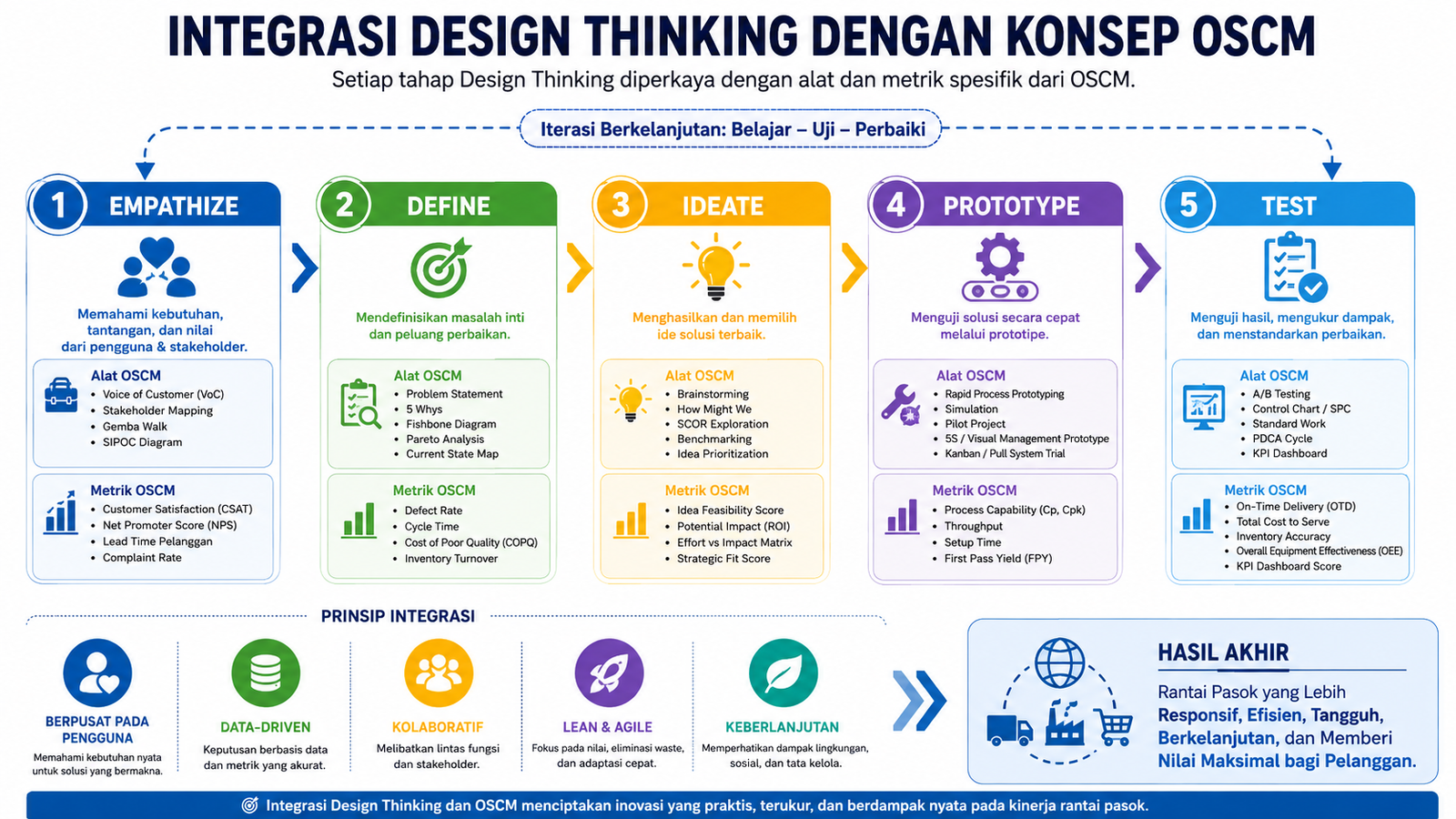
๐จ Sesi 14: Implementasi Design Thinking dalam Operasi
Topik: Integrasi Konsep OSCM melalui Design Thinking
Link Materi: https://aurinoworks.com/oscm-sesi-14/
Aktivitas: Lecture โข Discussion โข Workshop DT (Prototype Final)
๐ฏ Tujuan Sesi
Sesi ini merupakan kapstone/integrasi dari seluruh konsep OSCM yang telah dipelajari (Sesi 1-13). Mahasiswa diharapkan mampu:
- Mengintegrasikan konsep resource management, quality, dan lean operations
- Menerapkan Design Thinking untuk menyelesaikan masalah operasional nyata
- Merancang solusi yang layak secara operasional dan bernilai bagi pelanggan
- Menunjukkan kemampuan berpikir sistemik, analitis, dan kreatif
- Mempresentasikan solusi dengan justifikasi manajerial yang kuat
๐ Alur Design Thinking dalam OSCM
๐ 1. Design Thinking: Filosofi dan Kerangka Kerja
Apa itu Design Thinking?
Design Thinking adalah pendekatan iteratif dan berpusat pada manusia (human-centered) untuk inovasi dan pemecahan masalah yang kompleks, dengan mengintegrasikan kebutuhan pengguna, kemungkinan teknologi, dan persyaratan bisnis Stanford d.school.
Mengapa Design Thinking dalam OSCM?
Operasi tradisional seringkali fokus pada efisiensi internal saja. Design Thinking menambahkan dimensi:
- Customer-Centric: Memahami kebutuhan pelanggan secara mendalam
- Creative Problem Solving: Tidak terjebak pada solusi konvensional
- Iterative: Terus memperbaiki solusi berdasarkan feedback
- Cross-Functional: Melibatkan berbagai perspektif
- Action-Oriented: Fokus pada implementasi, bukan hanya analisis
Integrasi Design Thinking dengan OSCM:
| Konsep OSCM | Integrasi dengan Design Thinking | Contoh Aplikasi |
|---|---|---|
| Resource Management (Sesi 11) | Empathize: Pahami kebutuhan sumber daya dari perspektif pengguna | Desain kapasitas yang sesuai dengan pola permintaan pelanggan |
| Quality Management (Sesi 12) | Define: Rumuskan kualitas dari sudut pandang pelanggan | Quality dimensions yang relevan dengan customer needs |
| Lean Operations (Sesi 13) | Ideate & Prototype: Ciptakan solusi lean yang user-friendly | Eliminasi waste yang paling berdampak pada customer experience |
| Supply Chain | Test: Validasi solusi dengan stakeholder rantai pasok | Desain supply chain yang responsive dan resilient |
3 Lensa Inovasi (IDEO):
Desirability (Manusia): Apakah solusi ini diinginkan oleh pelanggan?
โฌ๏ธ
Feasibility (Teknologi): Apakah solusi ini mungkin diimplementasikan?
โฌ๏ธ
Viability (Bisnis): Apakah solusi ini berkelanjutan secara bisnis?
โฌ๏ธ
Innovation = Intersection of all three!
๐ฎ๐ฉ Contoh Lokal: Gojek – Design Thinking in Operations
Gojek menggunakan Design Thinking untuk mengembangkan layanan operasional mereka.
Empathize: Riset mendalam tentang kebutuhan driver dan pelanggan di Indonesia
Define: Masalah: “Bagaimana membuat layanan ojek lebih aman, terpercaya, dan mudah diakses?”
Ideate: Aplikasi mobile, sistem rating, GoPay, GoFood, dll
Prototype: MVP dengan fitur dasar, iterasi berdasarkan feedback
Test: Continuous improvement berdasarkan data dan user feedback
Hasil: Super app dengan 190+ juta pengguna, valuasi $10+ billion
๐ Contoh Global: IBM – Enterprise Design Thinking
IBM mengadopsi Design Thinking sebagai metodologi standar untuk transformasi bisnis dan operasi.
Framework:
- Hills: Statement of intent yang fokus pada user outcomes
- Playbacks: Regular check-ins dengan stakeholders
- Sponsor Users: Real users involved throughout the process
Impact: 2x faster time to market, 75% reduction in development time, 300% ROI on design initiatives
โค๏ธ 2. Tahap 1: Empathize – Memahami Pengguna dan Masalah Operasional
Tujuan Tahap Empathize
Mengembangkan pemahaman mendalam tentang masalah operasional dari perspektif pengguna (pelanggan, karyawan, supplier, stakeholder lainnya).
๐ฏ Empathize dalam Konteks OSCM
Fokus: Memahami pengalaman dan kebutuhan pengguna dalam berinteraksi dengan sistem operasi
Pertanyaan Kunci:
- Apa yang dirasakan pelanggan saat menggunakan layanan/produk kita?
- Apa pain points yang dialami karyawan dalam proses operasional?
- Bagaimana supplier mengalami proses collaboration dengan kita?
- Apa yang tidak terucapkan (unmet needs) oleh pengguna?
Tools untuk Empathize:
1. Customer Journey Mapping
Definisi: Visualisasi lengkap pengalaman pelanggan dalam berinteraksi dengan layanan/produk dari awal sampai akhir
Komponen:
- Stages: Awareness, Consideration, Purchase, Delivery, Usage, Support
- Touchpoints: Setiap titik interaksi (website, call center, physical store, dll)
- Actions: Apa yang dilakukan pelanggan di setiap tahap
- Emotions: Perasaan pelanggan (frustrated, delighted, confused, dll)
- Pain Points: Masalah yang dihadapi
- Opportunities: Area untuk improvement
Contoh: Journey pelanggan memesan makanan via GoFood
2. Empathy Map
4 Quadrants:
- Says: Apa yang diucapkan pengguna secara eksplisit
- Thinks: Apa yang dipikirkan (mungkin tidak diucapkan)
- Does: Perilaku yang terlihat
- Feels: Emosi yang dirasakan (frustrated, excited, anxious)
Contoh untuk pelanggan bank:
- Says: “Prosesnya lama sekali”
- Thinks: “Kenapa harus isi form berulang?”
- Does: Membandingkan dengan bank digital lain
- Feels: Frustrated, impatient
3. Shadowing & Observation
Metode: Mengamati pengguna secara langsung dalam konteks nyata
Aplikasi dalam OSCM:
- Shadow operator di lini produksi untuk pahami workflow
- Observe customer di toko untuk pahami shopping behavior
- Shadow delivery driver untuk pahami last-mile challenges
Prinsip: “Watch what they do, not just what they say”
4. In-Depth Interviews
Techniques:
- 5 Whys: Tanya “kenapa” 5 kali untuk sampai ke akar masalah
- Critical Incident Technique: Minta pengguna ceritakan pengalaman terbaik/terburuk
- Laddering: Dari fitur โ benefit โ value
Contoh Pertanyaan:
- “Ceritakan pengalaman terakhir Anda saat [menggunakan layanan X]”
- “Apa yang membuat Anda frustrasi dalam proses tersebut?”
- “Jika Anda punya tongkat ajaib, apa yang akan Anda ubah?”
5. Contextual Inquiry
Definisi: Kombinasi observasi dan interview di konteks nyata pengguna
Master-Apprentice Model:
- Researcher sebagai “apprentice” (belajar dari user)
- User sebagai “master” (mengajarkan cara mereka bekerja)
Aplikasi: Mengamati dan mewawancarai operator gudang sambil mereka bekerja
Output Tahap Empathize:
- Rich qualitative data tentang pengalaman pengguna
- Identifikasi pain points dan unmet needs
- Insights tentang behavior dan emotions
- Persona (representasi tipikal pengguna)
- Customer journey map yang detail
๐ฎ๐ฉ Contoh Lokal: Bank BCA – Empathize untuk Digital Banking
BCA melakukan riset empathize mendalam sebelum mengembangkan klikBCA dan BCA mobile.
Empathize Activities:
- Customer Interviews: 500+ nasabah dari berbagai segmen
- Shadowing: Mengamati nasabah saat bertransaksi di ATM dan cabang
- Diary Studies: Nasabah mencatat pengalaman banking selama 2 minggu
- Empathy Maps: Memahami fears, hopes, dan frustrations nasabah
Key Insights:
- Nasabah takut salah transfer dan tidak bisa recover
- Proses aktivasi terlalu rumit untuk non-tech-savvy users
- Nasabah ingin konfirmasi real-time untuk setiap transaksi
- Customer service sulit dihubungi saat urgent
Impact: Insights ini menjadi dasar desain BCA mobile yang user-friendly dan trusted
๐ Contoh Global: Airbnb – Empathize untuk Trust Building
Airbnb menggunakan empathize untuk memahami ketakutan host dan guest.
Empathize Research:
- Live with Hosts: Tim Airbnb tinggal bersama host untuk pahami pengalaman
- Guest Diaries: Guests mencatat perasaan sebelum, selama, setelah stay
- Support Ticket Analysis: Analisis ribuan keluhan untuk identify patterns
Key Insights:
- Hosts takut properti mereka rusak
- Guests takut listing tidak sesuai foto
- Keduanya butuh “trust signals” yang kuat
Solutions: Professional photography, review system, host guarantee, verified ID
๐ฏ 3. Tahap 2: Define – Merumuskan Masalah Operasional
Tujuan Tahap Define
Mensintesis insights dari tahap Empathize menjadi pernyataan masalah yang jelas, fokus, dan actionable.
๐ฏ Define dalam Konteks OSCM
Fokus: Mengubah data kualitatif yang kompleks menjadi problem statement yang tajam
Karakteristik Problem Statement yang Baik:
- Human-Centered: Fokus pada kebutuhan manusia, bukan teknologi
- Specific: Cukup spesifik untuk memberikan fokus
- Broad: Cukup luas untuk memberikan kebebasan kreatif
- Actionable: Memungkinkan untuk di-generate solusi
- Measurable: Bisa diukur keberhasilannya
Tools untuk Define:
1. Point of View (POV) Statement
Formula:
Contoh:
- “Seorang operator gudang (user) needs to menemukan spare parts dengan cepat (need) karena downtime mesin menyebabkan kerugian Rp 10 juta per jam (insight)”
- “Pelanggan e-commerce (user) needs to track paket secara real-time (need) karena anxiety tentang kapan paket sampai (insight)”
2. How Might We (HMW) Questions
Formula: “How might we [action] for [user] to [outcome]?”
Contoh:
- “How might we reduce waiting time di emergency room untuk pasien kritis?”
- “How might we make inventory counting lebih akurat dan cepat untuk staf gudang?”
- “How might we eliminate defect detection di akhir proses untuk operator produksi?”
Best Practices:
- Generate 10-20 HMW questions
- Vary the scope (some broad, some specific)
- Avoid solutions in the question
- Cluster dan prioritize
3. Problem Statement Canvas
Components:
- Current State: Bagaimana kondisi saat ini?
- Problem: Apa masalah utamanya?
- Impact: Apa dampaknya (quantified jika mungkin)?
- Root Causes: Apa akar penyebabnya?
- Constraints: Apa batasan-batasannya?
- Success Criteria: Bagaimana kita tahu sudah berhasil?
4. 5 Whys Analysis
Teknik: Tanya “Why” 5 kali untuk sampai ke akar masalah
Contoh dalam OSCM:
- Problem: Customer complaint rate tinggi
- Why 1: Produk sering rusak saat delivery
- Why 2: Packaging tidak memadai
- Why 3: Budget packaging dipotong untuk cost reduction
- Why 4: Tidak ada alignment antara cost target dan quality standards
- Why 5 (Root Cause): Tidak ada cross-functional decision making untuk trade-off decisions
Dari Insights ke Problem Statement:
| Insight dari Empathize | Problem Statement | HMW Question |
|---|---|---|
| Operator menghabiskan 30% waktu mencari tools | Operator butuh akses tools yang cepat untuk mengurangi idle time | |
| Pelanggan cemas menunggu delivery tanpa update | Pelanggan butuh visibility real-time untuk mengurangi anxiety | |
| Quality inspector overwhelmed dengan volume inspeksi | Inspector butuh bantuan untuk fokus pada critical defects |
Kriteria Problem Statement yang Efektif:
- โ User-Focused: “Seorang [user] membutuhkan…” bukan “Sistem kita harus…”
- โ Action-Oriented: Mengandung verb yang menunjukkan action
- โ Insight-Driven: Berdasarkan insight nyata, bukan asumsi
- โ Appropriately Scoped: Tidak terlalu luas (vague) atau terlalu sempit (prescriptive)
- โ Measurable: Bisa diukur keberhasilannya dengan KPI
๐ฎ๐ฉ Contoh Lokal: PT KAI – Define untuk Customer Experience
KAI melakukan define yang tajam sebelum transformasi layanan kereta api.
Insights dari Empathize:
- Penumpang frustrasi dengan antrian panjang dan ketidakpastian
- Proses boarding membingungkan untuk first-time users
- Informasi delay tidak transparan
Problem Statements:
- “Penumpang butuh cara cepat dan pasti untuk mendapatkan tiket tanpa antri fisik”
- “Penumpang butuh kejelasan real-time tentang status kereta untuk planning”
- “First-time users butuh guidance yang jelas saat boarding”
HMW Questions:
- HMW make ticket purchasing seamless untuk semua passengers?
- HMW provide real-time train status yang trustworthy?
- HMW make boarding process intuitive untuk first-timers?
Solutions: Online booking, KAI Access app dengan real-time tracking, boarding gate system
๐ Contoh Global: FedEx – Define for Delivery Experience
FedEx menggunakan define yang tajam untuk transformasi delivery experience.
Insight: “Customers feel anxious when they don’t know exactly when their package will arrive”
Problem Statement: “Online shoppers need precise delivery windows because waiting all day for a package is frustrating and unproductive”
HMW: “How might we provide delivery time windows so precise that customers can plan their day around them?”
Solutions: FedEx Delivery Manager, precise time windows, real-time tracking, photo proof of delivery
Results: Customer satisfaction naik 35%, missed deliveries turun 60%
๐ก 4. Tahap 3: Ideate – Menghasilkan Solusi Operasional Kreatif
Tujuan Tahap Ideate
Menghasilkan beragam alternatif solusi secara kreatif tanpa batasan, kemudian memilih yang paling promising untuk diprototipe.
๐ฏ Ideate dalam Konteks OSCM
Fokus: Generate solusi untuk masalah operasional yang telah didefinisikan
Prinsip:
- Defer Judgment: Jangan kritik ide saat brainstorming
- Encourage Wild Ideas: Ide gila bisa memicu inovasi
- Build on Others: “Yes, and…” bukan “No, but…”
- Go for Quantity: Semakin banyak ide, semakin baik
- One Conversation at a Time: Fokus dan dengarkan
- Be Visual: Sketsa ide, jangan hanya bicara
- Headline Ideas: Beri judul yang catchy
Tools untuk Ideate:
1. Brainstorming
Rules:
- No criticism (defer judgment)
- Wild ideas welcome
- Quantity over quality (initially)
- Build on others’ ideas
Process:
- Review problem statement (5 min)
- Individual ideation (10 min) – tulis ide di sticky notes
- Share ideas (15 min) – tempel di wall, share satu per satu
- Build and cluster (10 min) – kelompokkan ide serupa
- Select top ideas (10 min) – voting untuk ide terbaik
Target: 50-100 ideas in 50 minutes
2. Crazy 8s
Metode: Sketch 8 ide berbeda dalam 8 menit
Process:
- Fold kertas menjadi 8 bagian
- Setiap menit, sketch 1 ide di setiap bagian
- Jangan overthink, fokus pada quantity
- Setelah 8 menit, share dan discuss
Benefits: Memaksa keluar dari comfort zone, generate diverse ideas
3. SCAMPER Technique
SCAMPER adalah mnemonic untuk stimulate creative thinking:
- S – Substitute: Apa yang bisa diganti? (material, orang, proses)
- C – Combine: Apa yang bisa digabungkan? (langkah, fungsi)
- A – Adapt: Apa yang bisa diadaptasi dari konteks lain?
- M – Modify/Magnify: Apa yang bisa diubah/diperbesar?
- P – Put to other uses: Bisa digunakan untuk apa lagi?
- E – Eliminate: Apa yang bisa dihilangkan?
- R – Reverse/Rearrange: Bisa dibalik/diatur ulang?
Contoh dalam OSCM:
- Substitute: Ganti inspeksi manual dengan computer vision
- Combine: Gabungkan proses picking dan packing di gudang
- Eliminate: Hilangkan approval layer yang tidak perlu
- Reverse: Ubah push system menjadi pull system
4. Worst Possible Idea
Teknik: Sengaja generate ide TERBURUK, lalu reverse untuk dapat ide bagus
Process:
- Generate worst ideas (5 min)
- Discuss why they’re bad (5 min)
- Identify opposite qualities (5 min)
- Transform into good ideas (10 min)
Contoh:
- Worst Idea: “Make customer wait 2 weeks for delivery”
- Why Bad: Customers hate waiting, competitors deliver faster
- Opposite: “Deliver as fast as possible”
- Good Idea: “Same-day delivery for local orders”
5. Analogical Thinking
Teknik: Cari solusi dari industri/konteks lain yang mirip
Contoh:
- Problem: Hospital ER overcrowding
- Analogy: Formula 1 pit stops (fast, coordinated)
- Application: Create “pit crew” for ER patients
- Result: Virginia Mason Medical Center reduced ER wait time 60%
Pemilihan Ide (Convergent Thinking):
1. Dot Voting
Process:
- Setiap orang dapat 3-5 votes (dots)
- Vote untuk ide yang paling promising
- Count votes, identify top ideas
Tips: Gunakan warna berbeda untuk kriteria berbeda (desirability, feasibility, viability)
2. Impact-Effort Matrix
2×2 Matrix:
- High Impact, Low Effort: Quick Wins โ Do first!
- High Impact, High Effort: Major Projects โ Plan carefully
- Low Impact, Low Effort: Fill-ins โ Do if time permits
- Low Impact, High Effort: Thankless Tasks โ Avoid
3. Feasibility-Desirability-Viability Analysis
Score setiap ide pada 3 dimensi (1-10):
- Desirability: Seberapa diinginkan oleh pengguna?
- Feasibility: Seberapa mungkin diimplementasikan secara teknis?
- Viability: Seberapa sustainable secara bisnis?
Total Score = Desirability + Feasibility + Viability
Prioritas: Ide dengan total score tertinggi
Integrasi dengan Konsep OSCM:
Saat Ideate, Pertimbangkan:
- Resource Implications: Apakah solusi ini feasible dengan sumber daya yang ada?
- Quality Impact: Apakah solusi ini meningkatkan kualitas dari perspektif pelanggan?
- Lean Principles: Apakah solusi ini menghilangkan waste atau justru menambah?
- Supply Chain Effects: Bagaimana dampak pada supplier dan downstream?
- Scalability: Bisa di-scale up jika sukses?
๐ฎ๐ฉ Contoh Lokal: Tokopedia – Ideate untuk Seller Experience
Tokopedia melakukan brainstorming untuk improve seller experience.
Problem: “UMKM sellers struggle dengan proses listing produk yang rumit”
Brainstorming Session:
- Generated 80+ ideas dalam 1 jam
- Ide liar: “AI yang auto-generate listing dari foto produk”
- Ide praktis: “Template listing untuk kategori populer”
- Ide incremental: “Video tutorial step-by-step”
Selection Process:
- Dot voting untuk top 20 ideas
- Impact-Effort Matrix untuk prioritize
- Feasibility-Desirability-Viability scoring
Selected Ideas:
- Quick Win: Template listing (low effort, high impact)
- Major Project: AI-powered listing generator (high effort, high impact)
๐ Contoh Global: Amazon – Ideate for Last-Mile Delivery
Amazon brainstorming untuk solve last-mile delivery challenges.
Problem: “Customers want faster delivery but last-mile is expensive”
Diverse Ideas Generated:
- Drone delivery (wild idea)
- Delivery to car trunk (analogical thinking)
- Crowdsourced delivery (Uber-like model)
- Lockers di lokasi strategis (practical idea)
- Predictive shipping (ship before order)
Selected Solutions:
- Amazon Lockers (feasible, scalable)
- Amazon Flex (crowdsourced delivery)
- Prime Air (drone delivery – long term)
Results: Amazon Lockers di 15+ negara, Amazon Flex 100,000+ drivers
๐จ 5. Tahap 4: Prototype – Mewujudkan Solusi Operasional
Tujuan Tahap Prototype
Membuat representasi sederhana dan cepat dari solusi untuk dipelajari, diuji, dan diiterasi sebelum implementasi penuh.
๐ฏ Prototype dalam Konteks OSCM
Fokus: “Build to think” – membuat untuk memahami, bukan untuk presentasi
Prinsip:
- Quick & Dirty: Lebih baik prototype cepat daripada perfect yang lama
- Don’t Get Attached: Prototype disposable, siap dibuang dan diganti
- Test Assumptions: Setiap prototype menguji asumsi spesifik
- Iterate: Prototype โ Test โ Learn โ Iterate
- Right Fidelity: Tidak perlu high-fidelity di awal
Types of Prototypes dalam OSCM:
1. Paper Prototypes
Definisi: Sketsa manual di kertas untuk visualisasi konsep
Aplikasi dalam OSCM:
- Layout fasilitas baru (sketsa floor plan)
- Flowchart proses baru
- Mockup form atau dokumen
- Storyboard untuk customer journey baru
Benefits: Cepat, murah, mudah diubah, collaborative
2. Physical Prototypes
Definisi: Mockup fisik dari produk atau workspace
Aplikasi dalam OSCM:
- Mockup workstation dengan cardboard dan foam
- Scale model layout pabrik/gudang
- Mockup packaging design
- Full-scale mockup untuk ergonomic testing
Contoh: Boeing membuat full-scale mockup cockpit sebelum production
3. Digital Prototypes
Definisi: Prototype menggunakan software/digital tools
Aplikasi dalam OSCM:
- Wireframes untuk aplikasi/aplikasi internal
- Simulasi proses menggunakan software (Arena, AnyLogic)
- Digital twin dari fasilitas
- 3D modeling untuk product design
Tools: Figma, Sketch, Adobe XD, Simio, FlexSim
4. Process Prototypes (Role-Play)
Definisi: Simulasi proses baru dengan role-playing
Aplikasi dalam OSCM:
- Role-play customer service scenario baru
- Walk-through proses assembly baru
- Simulation of warehouse operations
- Tabletop exercise untuk crisis management
Benefits: Low-cost, identify issues early, train employees
5. Pilot Programs
Definisi: Implementasi solusi dalam skala kecil sebelum full rollout
Aplikasi dalam OSCM:
- Pilot di satu lini produksi sebelum plant-wide
- Pilot di satu cabang sebelum nasional
- Pilot dengan satu segmen pelanggan
- Pilot dengan satu supplier
Best Practices:
- Define success criteria sebelum pilot
- Collect data systematically
- Document learnings
- Iterate sebelum scale-up
6. Storyboards
Definisi: Visual sequence yang menceritakan pengalaman pengguna dengan solusi baru
Aplikasi dalam OSCM:
- Storyboard customer journey baru
- Storyboard operator workflow baru
- Storyboard delivery process baru
Components: Characters,ๅบๆฏ, actions, emotions, dialogue
Prototyping Principles untuk OSCM:
| Principle | Description | Example |
|---|---|---|
| Start Simple | Mulai dengan low-fidelity, iterate ke high-fidelity | |
| Test One Thing | ||
| Fail Fast | ||
| Involve Users | ||
| Measure Learning |
Prototyping Roadmap:
Phase 1: Low-Fidelity (Days 1-3)
Paper sketches, cardboard mockups, role-plays
โฌ๏ธ
Phase 2: Medium-Fidelity (Weeks 1-2)
Digital wireframes, process simulations, small-scale pilots
โฌ๏ธ
Phase 3: High-Fidelity (Weeks 3-8)
Functional prototypes, pilot programs, beta testing
โฌ๏ธ
Phase 4: Implementation (Months 3+)
Full-scale rollout based on learnings
๐ฎ๐ฉ Contoh Lokal: PT PLN – Prototype for Smart Grid
PLN melakukan prototyping bertahap untuk implementasi smart grid.
Prototype Journey:
- Phase 1 (Low-Fi): Paper mockup dashboard untuk monitoring, role-play dengan operator
- Phase 2 (Medium-Fi): Digital dashboard prototype, pilot di 1 gardu
- Phase 3 (High-Fi): Functional prototype di 10 gardu, integration testing
- Phase 4 (Pilot): Pilot di 1 wilayah (100 gardu), 6 bulan
- Phase 5 (Scale): Rollout nasional setelah iterasi
Learnings dari Prototyping:
- Operator butuh simplified interface (bukan complex dashboard)
- Alert system harus prioritized (bukan semua alerts sama)
- Mobile access critical untuk field technicians
Impact: Saved 2+ years dan Rp 50 miliar dari early prototyping
๐ Contoh Global: Zara – Rapid Prototyping in Fashion Operations
Zara adalah master rapid prototyping di fast fashion.
Prototype Process:
- Design Prototype (2 weeks): Sketch โ Pattern โ Sample
- Small Batch Production (50-100 units): Test di select stores
- Customer Feedback (1 week): Collect sales data dan customer reactions
- Iterate atau Scale: Modify design atau ramp up production
- Full Production (if successful): Scale to all stores
Results:
- Design-to-store: 2-3 weeks (vs industry avg 6 months)
- 85% of products are profitable (vs industry avg 60-70%)
- Only 15-20% of products need markdown (vs industry avg 30-40%)
Key: Treat every new design as a prototype, learn fast, iterate or kill
๐งช 6. Tahap 5: Test – Validasi dan Iterasi Solusi
Tujuan Tahap Test
Menguji prototype dengan pengguna nyata untuk mengumpulkan feedback, memvalidasi asumsi, dan mengiterasi solusi.
๐ฏ Test dalam Konteks OSCM
Fokus: “Test as if you’re right, listen as if you’re wrong”
Prinsip:
- Test Early and Often: Jangan tunggu sampai perfect
- Test with Real Users: Bukan internal team saja
- Observe, Don’t Tell: Biarkan users explore sendiri
- Learn, Don’t Sell: Tujuannya belajar, bukan convince
- Iterate Based on Feedback: Test โ Learn โ Iterate โ Test again
Testing Methods untuk OSCM:
1. Usability Testing
Definisi: Observasi pengguna saat menggunakan prototype untuk identify usability issues
Process:
- Recruit 5-8 representative users
- Prepare tasks untuk users complete
- Observe users (think aloud protocol)
- Collect metrics (time, errors, satisfaction)
- Analyze dan identify patterns
Metrics:
- Task completion rate
- Time on task
- Error rate
- User satisfaction (SUS score)
Contoh: Test prototype aplikasi warehouse management dengan operators
2. A/B Testing
Definisi: Compare 2 versions untuk determine which performs better
Process:
- Create 2 variants (A dan B)
- Randomly assign users to A atau B
- Measure key metrics untuk both
- Statistical analysis untuk determine winner
Contoh dalam OSCM:
- A/B test 2 layout gudang untuk measure picking efficiency
- A/B test 2 proses checkout untuk measure completion rate
- A/B test 2 delivery time windows untuk measure customer satisfaction
3. Pilot Testing
Definisi: Implementasi solusi dalam skala kecil di real environment
Best Practices:
- Define success criteria SEBELUM pilot
- Select representative pilot site/users
- Collect both quantitative dan qualitative data
- Document learnings systematically
- Iterate sebelum scale-up
Contoh: Pilot new inventory system di 1 warehouse sebelum rollout ke 50 warehouses
4. Feedback Interviews
Definisi: Structured interviews setelah users menggunakan prototype
Question Types:
- Task-based: “Bagaimana Anda menyelesaikan task X?”
- Reflection: “Apa yang paling membantu? Apa yang membingungkan?”
- Comparative: “Bagaimana dibandingkan dengan cara lama?”
- Improvement: “Apa yang akan Anda ubah?”
5. Metrics-Based Testing
KPIs untuk OSCM Solutions:
| Category | Metrics | Target |
|---|---|---|
| Efficiency | Cycle time, throughput, productivity | Improve 20%+ |
| Quality | Defect rate, error rate, rework rate | Reduce 50%+ |
| Cost | Cost per unit, labor cost, material cost | Reduce 15%+ |
| Customer Satisfaction | NPS, CSAT, complaint rate | Improve 25%+ |
| Employee Satisfaction | Engagement score, turnover rate | Improve 20%+ |
Iterasi Berdasarkan Feedback:
Test Prototype
โฌ๏ธ
Collect Feedback (quantitative + qualitative)
โฌ๏ธ
Analyze Results (what worked, what didn’t, why)
โฌ๏ธ
Identify Improvements (prioritize by impact)
โฌ๏ธ
Iterate Prototype (make changes)
โฌ๏ธ
Test Again (repeat cycle)
โฌ๏ธ
Continue until success criteria met
Decision Framework: Pivot, Persevere, atau Iterate?
| Scenario | Action | Criteria |
|---|---|---|
| Major Issues | Pivot | Fundamental assumptions wrong, users don’t want it |
| Minor Issues | Iterate | Concept valid, needs refinement |
| Success Criteria Met | Persevere & Scale | Working well, ready for full implementation |
๐ฎ๐ฉ Contoh Lokal: Gojek – Testing GoFood Features
Gojek melakukan testing iteratif untuk fitur-fitur GoFood.
Testing Journey:
- Prototype 1: Basic ordering flow
- Test 1: 50 users, usability testing
- Feedback: Users confused about delivery time estimation
- Iterate 1: Added clear delivery time display
- Test 2: 100 users, A/B test new vs old
- Results: Completion rate naik dari 65% ke 85%
- Iterate 2: Added real-time tracking
- Test 3: Pilot di 1 kota, 1000 users
- Results: Customer satisfaction naik 40%
- Scale: Rollout nasional
Key Learning: Each iteration uncovered issues yang tidak terduga, proving value of iterative testing
๐ Contoh Global: Toyota – Testing New Production Systems
Toyota terkenal dengan rigorous testing sebelum full implementation.
Testing Process:
- Phase 1: Simulation – Computer simulation of new process
- Phase 2: Lab Testing – Small-scale physical prototype
- Phase 3: Pilot Line – Test in dedicated pilot area
- Phase 4: Pilot Plant – Test in one production plant
- Phase 5: Limited Rollout – Test in few plants
- Phase 6: Full Rollout – Deploy to all plants
Example: New Assembly Line
- 2 years of testing before full implementation
- 1000+ test cycles
- 50+ iterations based on feedback
- Result: 30% productivity improvement, zero defects at launch
Philosophy: “Test thoroughly, implement smoothly” – never rush to full scale without proper validation
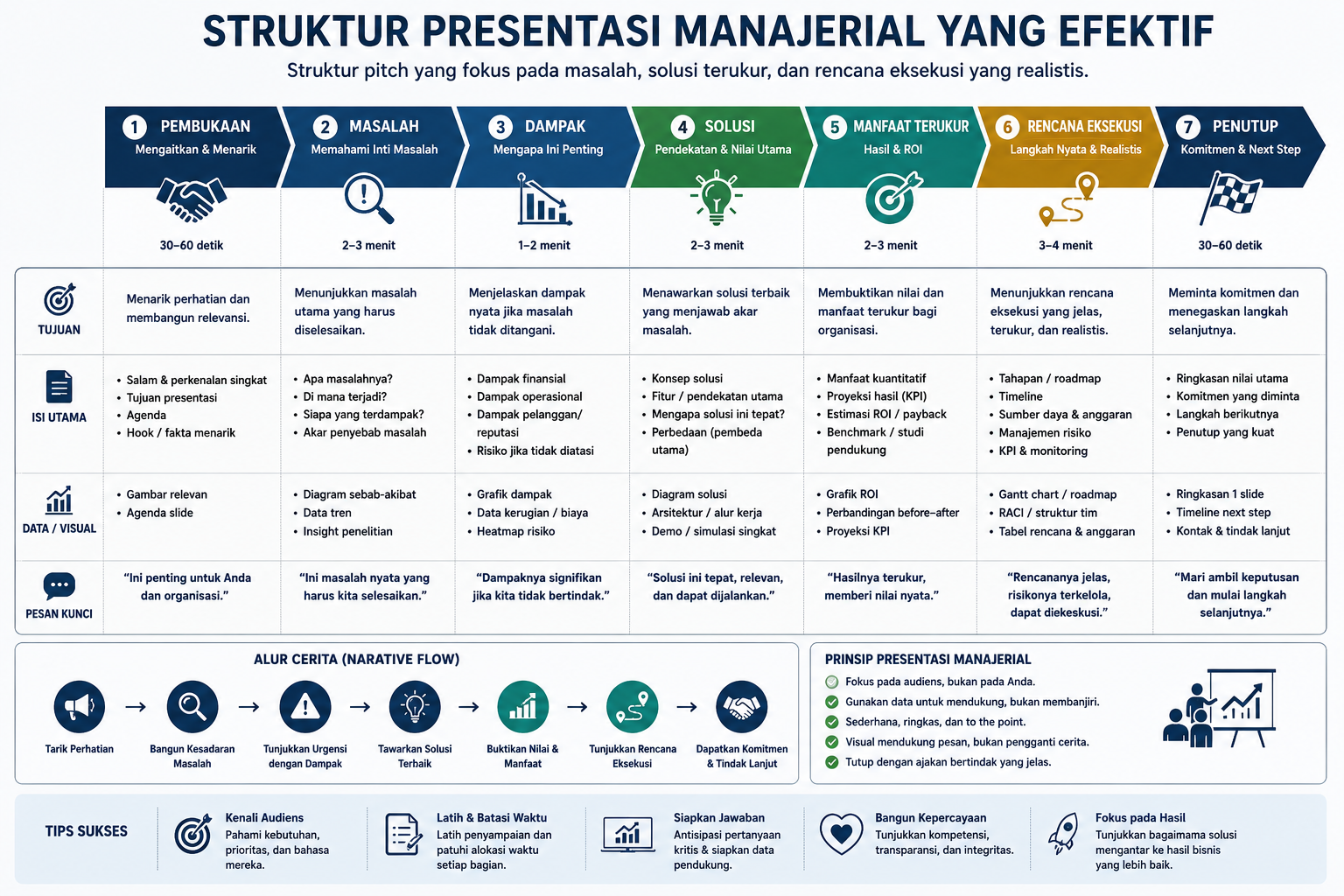
๐ 7. Presentasi Manajerial dan Justifikasi Keputusan
Tujuan Presentasi Manajerial
Mengkomunikasikan solusi operasional dengan jelas, persuasif, dan actionable kepada stakeholders untuk mendapatkan buy-in dan approval.
๐ฏ Prinsip Presentasi Manajerial yang Efektif
- Audience-Centric: Fokus pada apa yang penting bagi audience
- Story-Driven: Ceritakan narrative, bukan hanya data
- Evidence-Based: Justifikasi dengan data dan insights
- Action-Oriented: Clear recommendations dan next steps
- Concise: Respect audience’s time, focus on essentials
Struktur Presentasi Manajerial:
1. Executive Summary (1 slide)
Components:
- Problem statement (1 sentence)
- Proposed solution (1 sentence)
- Key benefits (3 bullets)
- Investment required (1 number)
- Expected ROI (1 number)
- Timeline (1 number)
Principle: If they only read this slide, they should understand everything
2. Problem & Context (2-3 slides)
Content:
- Current situation (what’s happening now)
- Pain points (what’s wrong)
- Impact (quantified: cost, time, quality, customer satisfaction)
- Root causes (why it’s happening)
- User insights (from empathy research)
Tips: Use customer quotes, photos, videos to make it real
3. Solution Overview (2-3 slides)
Content:
- Proposed solution (what we recommend)
- How it works (high-level overview)
- Key features/components
- Visual: diagrams, mockups, prototypes
- Why this solution (rationale)
Tips: Show, don’t tell – use visuals liberally
4. Design Thinking Process (2-3 slides)
Content:
- Brief overview of DT process followed
- Key insights from each phase
- How insights led to solution
- Iterations and learnings
Tips: Show rigor, not just creativity – demonstrate systematic approach
5. Business Case (3-4 slides)
Content:
- Benefits:
- Quantitative: cost savings, revenue increase, efficiency gains
- Qualitative: customer satisfaction, employee morale, brand reputation
- Costs:
- Investment: CAPEX, OPEX
- Resources: people, time, technology
- ROI Analysis:
- Payback period
- NPV (Net Present Value)
- IRR (Internal Rate of Return)
- Risks & Mitigation:
- Key risks identified
- Mitigation strategies
6. Implementation Plan (2-3 slides)
Content:
- Phases dan milestones
- Timeline (Gantt chart)
- Resources required
- Key dependencies
- Success metrics dan KPIs
- Governance structure
Tips: Be realistic, show you’ve thought through execution
7. Recommendations & Next Steps (1 slide)
Content:
- Clear recommendation (what you want approved)
- Immediate next steps (what happens if approved)
- Decision required (what you need from audience)
- Timeline for decision
Tips: End with clear call to action
Justifikasi Keputusan Operasional:
Framework untuk Justifikasi:
| Dimension | Question to Answer | Evidence Needed |
|---|---|---|
| Strategic Alignment | How does this align with company strategy? | Link to strategic goals, OKRs |
| Customer Impact | How does this benefit customers? | User research, satisfaction metrics |
| Operational Feasibility | Can we actually implement this? | Technical assessment, resource analysis |
| Financial Viability | Does this make financial sense? | Cost-benefit analysis, ROI calculation |
| Risk Management | What could go wrong and how do we mitigate? | Risk assessment, mitigation plans |
| Competitive Advantage | Does this give us an edge? | Competitive analysis, benchmarking |
Tips untuk Presentasi yang Memukau:
- Start with Why: Begin with purpose, not details
- Use Stories: Customer stories make it real
- Show Prototypes: Bring prototypes to life, let audience experience
- Anticipate Questions: Prepare for tough questions, have backup slides
- Practice: Rehearse multiple times, time yourself
- Engage Audience: Ask questions, make it interactive
- Be Passionate: Show you believe in the solution
- End Strong: Clear call to action, memorable closing
๐ฎ๐ฉ Contoh Lokal: Presentasi Transformasi Digital di Bank BRI
BRI melakukan presentasi manajerial untuk transformasi digital banking.
Executive Summary:
- Problem: 70% transaksi masih di cabang, biaya operasional tinggi
- Solution: Super app BRImo dengan fitur lengkap
- Benefits: Cost savings Rp 2T/year, customer satisfaction +30%
- Investment: Rp 500B over 3 years
- ROI: 400% over 5 years, payback 18 months
Key Slides:
- Customer journey before vs after (visual)
- Prototype demo (live demo of app)
- Pilot results (data dari 6 bulan pilot)
- Financial model (detailed projections)
- Implementation roadmap (phased approach)
Result: Board approved, BRImo launched, 50+ million users in 2 years
๐ Contoh Global: Amazon Presentations – 6-Page Memo
Amazon terkenal dengan format presentasi yang unik: 6-page narrative memo.
Structure:
- Page 1: Context dan problem statement
- Page 2: Tenets (guiding principles)
- Page 3: Solution details
- Page 4: Customer experience (dengan metrics)
- Page 5: Financials dan business case
- Page 6: Implementation plan dan timeline
Rules:
- No PowerPoint, only narrative text
- Silent reading at start of meeting (15-30 min)
- Then discussion dan Q&A
- Must be crystal clear, no jargon
Philosophy: “If you can’t write it clearly, you don’t understand it well enough”
๐ 8. Integrasi Design Thinking dengan Konsep OSCM
Design Thinking sebagai Integrator
Design Thinking berfungsi sebagai framework integratif yang menyatukan seluruh konsep OSCM yang telah dipelajari.
Bagaimana Design Thinking Mengintegrasikan OSCM:
| Konsep OSCM | Peran dalam Design Thinking | Contoh Aplikasi |
|---|---|---|
| Resource Management | Informasi input untuk feasibility analysis | Evaluasi apakah solusi feasible dengan resources available |
| Quality Management | Framework untuk define quality dari customer perspective | Use SERVQUAL dimensions untuk evaluate service quality |
| Lean Operations | Prinsip untuk eliminate waste dalam solusi | Apply 7 wastes framework untuk identify improvement areas |
| Supply Chain | Context untuk understand end-to-end value chain | Consider supplier dan customer impacts in solution design |
| Process Design | Tools untuk design dan optimize processes | Use process mapping untuk prototype new workflows |
| Capacity Planning | Analysis untuk ensure solution is scalable | Evaluate capacity requirements for proposed solution |
Case Study: Integrasi Holistik
Problem: High Customer Complaints di E-Commerce Platform
Design Thinking Approach:
- Empathize:
- Interview 50 customers who complained
- Shadow customer service agents
- Analyze 10,000 complaint tickets
- Insight: Customers frustrated dengan lack of proactive communication
- Define:
- Problem: “Customers need proactive updates karena uncertainty causes anxiety”
- HMW: “How might we provide proactive, personalized updates untuk reduce customer anxiety?”
- Ideate:
- Generated 60+ ideas
- Selected: Real-time notification system dengan personalized messages
- Prototype:
- Paper mockup notification flow
- Digital prototype notification system
- Pilot dengan 1000 customers
- Test:
- A/B test notification vs no notification
- Measure: complaint rate, satisfaction score, NPS
- Iterate based on feedback (3 cycles)
Integration dengan OSCM Concepts:
- Quality: Improved service quality (responsiveness, assurance)
- Lean: Reduced waste (complaint handling time, rework)
- Resource: Optimized customer service resources (proactive vs reactive)
- Process: Redesigned communication process
- Supply Chain: Integrated dengan logistics untuk real-time updates
Results:
- Complaints turun 45%
- Customer satisfaction naik 35%
- NPS dari +20 ke +55
- Customer service cost turun 20% (less reactive work)
Framework untuk Integrasi:
Checklist untuk Setiap Solusi:
1. Customer Perspective (Desirability)
- โ Apakah solusi ini benar-benar menjawab kebutuhan pelanggan?
- โ Apakah customer experience improved?
- โ Apakah quality dimensions addressed?
2. Operational Perspective (Feasibility)
- โ Apakah resources available untuk implementasi?
- โ Apakah capacity sufficient?
- โ Apakah processes bisa di-redesign?
- โ Apakah waste eliminated atau reduced?
3. Business Perspective (Viability)
- โ Apakah ROI positive?
- โ Apakah aligned dengan strategic goals?
- โ Apakah sustainable long-term?
- โ Apakah competitive advantage created?
4. Supply Chain Perspective
- โ Bagaimana impact pada suppliers?
- โ Bagaimana impact pada downstream?
- โ Apakah collaboration improved?
๐ฎ๐ฉ Contoh Lokal: Integrasi di PT Semen Indonesia
Semen Indonesia menggunakan Design Thinking untuk integrasi OSCM concepts dalam transformasi operasional.
Project: Smart Factory Implementation
- Empathize: Riset dengan operators, maintenance team, customers
- Define: “Operators need real-time visibility untuk optimize production”
- Ideate: IoT sensors, AI analytics, mobile dashboards
- Prototype: Pilot di 1 production line
- Test: 6 bulan pilot, iterate 3x
OSCM Integration:
- Resource: Optimized manpower allocation berdasarkan real-time data
- Quality: Real-time quality monitoring, predictive quality
- Lean: Eliminated waste (waiting, defects, overproduction)
- Supply Chain: Integrated dengan supplier systems untuk JIT delivery
Results: OEE naik 25%, energy consumption turun 15%, quality defects turun 40%
๐ Contoh Global: Tesla – Holistic OSCM Integration
Tesla menggunakan Design Thinking untuk integrate semua OSCM concepts.
Example: Gigafactory Design
- Empathize: Deep understanding of customer needs (fast delivery, customization)
- Define: “How might we produce cars faster, cheaper, and more sustainably?”
- Ideate: Vertical integration, automation, direct sales
- Prototype: Pilot production lines, iterate rapidly
- Test: Continuous testing dan improvement
OSCM Integration:
- Resource: Vertical integration untuk control resources
- Quality: Over-the-air updates untuk continuous quality improvement
- Lean: Gigacasting (reduce 370 parts to 1), extreme automation
- Supply Chain: Direct supplier integration, co-location
- Process: Software-defined manufacturing
Results: Production cost 30% lower than competitors, fastest production ramp-up in auto industry
๐ 9. Referensi dan Bahan Bacaan Lanjutan
Referensi Utama:
- Collier, D. A., & Evans, J. R. (2021). Operations and Supply Chain Management. Boston: Cengage. (Integrasi konsep OSCM)
Buku Design Thinking:
- Brown, T. (2019). Change by Design: How Design Thinking Transforms Organizations and Inspires Innovation. Harper Business.
- Knapp, J., Zeratsky, J., & Kowitz, B. (2016). Sprint: How to Solve Big Problems and Test New Ideas in Just Five Days. Simon & Schuster.
- Kelly, T., & Kelley, D. (2013). Creative Confidence: Unleashing the Creative Potential Within Us All. Crown Business.
- Liedtka, J., & Ogilvie, T. (2011). Designing for Growth: A Design Thinking Tool Kit for Managers. Columbia Business School Publishing.
- Dorst, T. (2015). Frame Innovation: Create New Thinking by Design. MIT Press.
Books tentang OSCM Integration:
- Liker, J. K. (2004). The Toyota Way: 14 Management Principles from the World’s Greatest Manufacturer. McGraw-Hill.
- Womack, J. P., & Jones, D. T. (2003). Lean Thinking: Banish Waste and Create Wealth in Your Corporation. Free Press.
- Imai, M. (1986). Kaizen: The Key to Japan’s Competitive Success. McGraw-Hill.
- Slack, N., & Brandon-Jones, A. (2019). Operations Management. Pearson.
Articles & Papers:
- IDEO. (2015). “Design Thinking.” Harvard Business Review.
- Martin, R. (2009). “The Design of Business.” Harvard Business Review Press.
- Stickdorn, M., & Schneider, J. (2011). “This is Service Design Thinking.” BIS Publishers.
- Pine, B. J., & Gilmore, J. H. (1999). “The Experience Economy.” Harvard Business School Press.
Online Resources:
- Stanford d.school: dschool.stanford.edu
- IDEO U: ideou.com
- Design Thinking Toolkit: designthinking.toolkit.ibm.com
- Lean Enterprise Institute: lean.org
- ASQ (American Society for Quality): asq.org
Videos & Courses:
- Kunjungi channel YouTube untuk video kuliah sesi 14
- Link: https://aurinoworks.com/oscm-sesi-14/
- Workshop DT: Prototype Final Presentation
- Coursera: “Design Thinking for Innovation” by University of Virginia
- edX: “Lean Production” by MITx
Tools & Templates:
- Design Thinking Toolkit (IBM): Templates untuk semua phases
- Miro/Mural: Online collaboration untuk Design Thinking
- Figma: Prototyping tool
- Canva: Visual design untuk presentations
- Notion: Documentation dan project management
๐ Ringkasan Materi Sesi 14
Implementasi Design Thinking dalam Operasi adalah sesi integrasi yang menggabungkan seluruh konsep OSCM melalui pendekatan human-centered untuk menciptakan solusi operasional yang inovatif dan berkelanjutan.
Key Takeaways:
- Design Thinking adalah framework iteratif dan human-centered untuk inovasi
- 5 Tahapan: Empathize โ Define โ Ideate โ Prototype โ Test
- Empathize: Pahami pengguna secara mendalam (customer journey, empathy map, shadowing)
- Define: Rumuskan masalah dengan tajam (POV statement, HMW questions)
- Ideate: Generate solusi kreatif (brainstorming, SCAMPER, analogical thinking)
- Prototype: Wujudkan solusi sederhana (paper, physical, digital, pilot)
- Test: Validasi dengan pengguna nyata (usability testing, A/B testing, pilot)
- Presentasi Manajerial: Komunikasikan dengan jelas dan persuasif
- Integrasi OSCM: Gabungkan resource management, quality, lean, supply chain
- 3 Lensa Inovasi: Desirability, Feasibility, Viability
Contoh Penerapan:
- Lokal: Gojek (super app), BCA (digital banking), KAI (customer experience), Tokopedia (seller experience), PLN (smart grid), BRI (digital transformation), Semen Indonesia (smart factory)
- Global: IBM (enterprise design thinking), Airbnb (trust building), FedEx (delivery experience), Amazon (last-mile, 6-page memo), Toyota (testing rigor), Zara (rapid prototyping), Tesla (holistic integration)
Workshop DT – Prototype Final:
- Presentasi hasil Design Thinking project
- Demonstrasi prototype
- Justifikasi keputusan operasional
- Q&A dengan panel evaluators
- Feedback untuk continuous improvement
๐ Learning Path OSCM Selesai!
Selamat! Anda telah menyelesaikan seluruh learning path OSCM dari Sesi 1 sampai Sesi 14. Anda sekarang memiliki pemahaman komprehensif tentang:
- Operations & Supply Chain Management fundamentals
- Resource Management & Capacity Planning
- Quality Management & Continuous Improvement
- Lean Operations & Waste Elimination
- Design Thinking for Operational Innovation
Selamat menerapkan konsep-konsep ini dalam karir Anda!
Implementasi Design Thinking dalam Operasi


4
1. Tujuan Sesi
Sesi ini bertujuan mengintegrasikan seluruh konsep OSCM melalui penerapan Design Thinking pada masalah operasional nyata. Mahasiswa diharapkan mampu menunjukkan kemampuan berpikir sistemik, analitis, dan kreatif dalam merancang solusi yang layak secara operasional dan bernilai bagi pelanggan.
Fokus utama sesi ini adalah implementasi, bukan sekadar pemahaman konsep.
2. Peran Design Thinking dalam Penyelesaian Masalah Operasi
Design Thinking digunakan sebagai kerangka untuk memahami masalah operasi dari sudut pandang pengguna, baik pelanggan internal maupun eksternal. Pendekatan ini membantu mahasiswa menghindari solusi teknis yang tidak menjawab kebutuhan nyata.
Mahasiswa diarahkan untuk mengaitkan empati pelanggan dengan keputusan proses, kapasitas, kualitas, dan rantai pasok.
3. Tahap Empathy dan Define dalam Konteks Operasi
Pada tahap Empathy, mahasiswa melakukan observasi dan pengumpulan data untuk memahami masalah operasional. Tahap Define digunakan untuk merumuskan masalah secara jelas dan fokus.
Input: data lapangan, wawancara, observasi proses
Proses: pemetaan pengalaman, identifikasi pain points
Output: pernyataan masalah operasional yang terdefinisi dengan baik
4. Tahap Ideate dan Pemilihan Solusi Operasional
Tahap Ideate mendorong mahasiswa menghasilkan berbagai alternatif solusi tanpa langsung membatasi kreativitas. Dari berbagai ide tersebut, dipilih solusi yang paling relevan dan realistis secara operasional.
Mahasiswa belajar menyeimbangkan kreativitas dan kelayakan implementasi.
5. Tahap Prototype dalam Sistem Operasi
Prototipe diwujudkan dalam bentuk sederhana, seperti diagram proses baru, simulasi alur kerja, atau rancangan tata letak fasilitas. Prototipe memungkinkan pengujian solusi tanpa risiko besar.
Input: ide solusi terpilih
Proses: pembuatan prototipe operasional
Output: rancangan solusi yang siap diuji
6. Tahap Test dan Evaluasi Solusi
Tahap Test digunakan untuk mengevaluasi prototipe melalui umpan balik pengguna dan analisis dampak operasional. Evaluasi mencakup aspek biaya, kualitas, waktu, dan risiko.
Mahasiswa diarahkan untuk menggunakan hasil pengujian sebagai dasar penyempurnaan solusi.
7. Presentasi Manajerial dan Justifikasi Keputusan
Presentasi akhir harus menampilkan alur Design Thinking secara jelas dan terintegrasi dengan konsep OSCM. Setiap keputusan perlu dijustifikasi menggunakan logika operasional dan implikasi manajerial.
Kemampuan komunikasi dan argumentasi menjadi bagian penting dari penilaian.
8. ๐ฅ Video Pendukung
Tambahkan video pengantar tentang:
Design Thinking Implementation for Business Operations
atau
Design Thinking Case Presentation
๐ Catatan:
Video digunakan untuk memberikan gambaran implementasi Design Thinking dalam konteks bisnis dan operasi nyata.
Key Takeaway
Keunggulan dalam OSCM ditunjukkan melalui kemampuan mengintegrasikan konsep, memahami kebutuhan pengguna, dan mengimplementasikan solusi operasional secara sistemik.