🚀 Sesi 13: Lean Operations
Referensi Utama: Collier, D. A., & Evans, J. R. (2021). Operations and Supply Chain Management. Chapter 18. Boston: Cengage.
Link Materi: https://aurinoworks.com/oscm-sesi-13/
Aktivitas: Lecture • Discussion • Workshop
🎯 Capaian Pembelajaran
- Memahami filosofi dan prinsip Lean Operations
- Mengidentifikasi 7 Waste (Muda) dalam operasi
- Menerapkan tools Lean: 5S, Value Stream Mapping, Kanban, Poka-Yoke
- Menganalisis Just-In-Time (JIT) dan Pull Systems
- Mengevaluasi implementasi Lean di manufaktur dan jasa
- Menganalisis studi kasus Lean Operations di perusahaan lokal dan global
📖 1. Filosofi dan Sejarah Lean Operations
Definisi Lean Operations
Lean Operations adalah filosofi manajemen yang berfokus pada penghapusan waste (pemborosan) secara sistematis untuk menciptakan value maksimal bagi pelanggan dengan sumber daya minimal Womack & Jones.
Sejarah Lean: Dari Toyota ke Dunia
| Era | Tokoh | Kontribusi |
|---|---|---|
| 1900-an Awal | Henry Ford | Flow production, assembly line, standardization |
| 1930-1950 | Sakichi Toyoda, Kiichiro Toyoda | Jidoka (autonomation), JIT concept awal |
| 1950-1970 | Taiichi Ohno, Shigeo Shingo | Toyota Production System (TPS), 7 Waste, SMED, Poka-Yoke |
| 1980-an | Womack, Jones, Roos | “The Machine That Changed the World” (1990) – memperkenalkan istilah “Lean” |
| 1990-2000 | Lean Enterprise Institute | Lean thinking, Lean Six Sigma, Lean healthcare, Lean startup |
| 2010-Sekarang | Lean 4.0 | Integrasi Lean dengan Industry 4.0, digital Lean |
5 Prinsip Lean Thinking (Womack & Jones):
- Value: Definisikan value dari perspektif pelanggan
- Apa yang bersedia dibayar pelanggan?
- Fokus pada customer needs, bukan internal preferences
- Value Stream: Identifikasi semua langkah dalam value stream
- Map seluruh proses dari raw material sampai customer
- Kategorikan: Value-Added, Non-Value-Added but Necessary, Pure Waste
- Flow: Buat value mengalir tanpa hambatan
- Eliminasi bottleneck, batch processing, waiting
- Continuous flow, single-piece flow
- Pull: Biarkan customer yang “pull” produk
- Produksi hanya saat ada permintaan
- Jangan overproduce berdasarkan forecast
- Perfection: Kejar kesempurnaan melalui continuous improvement
- Kaizen, PDCA cycle
- Never-ending journey
🌍 Contoh Global: Toyota Motor Corporation
Toyota adalah birthplace of Lean dengan Toyota Production System (TPS) yang menjadi standar global.
Philosophy:
- The Toyota Way (2001): 14 principles yang menjadi DNA perusahaan
- Respect for People: Karyawan adalah aset terbesar
- Continuous Improvement: Kaizen adalah cara hidup
- Genchi Genbutsu: “Go and see” – pergi ke lokasi untuk memahami masalah
Hasil: Toyota menjadi produsen mobil terbesar dunia dengan profit margin 2x industry average.
🗑️ 2. The 7 Wastes (Muda)
Apa itu Muda?
Muda (無駄) adalah istilah Jepang untuk waste atau pemborosan. Taiichi Ohno mengidentifikasi 7 jenis waste yang harus dieliminasi dalam operasi TPS.
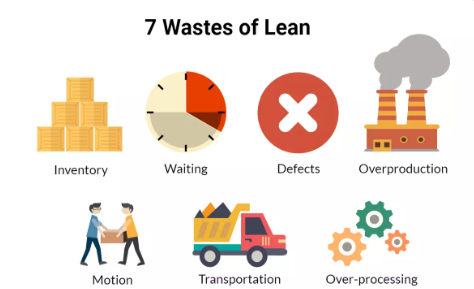
The 7 Wastes (TIMWOOD):
1. Transportation (Transportasi Berlebih)
Definisi: Pergerakan material atau produk yang tidak menambah value
Contoh:
- Material dipindahkan antar gedung berkali-kali
- Layout pabrik yang buruk menyebabkan jarak tempuh panjang
- Conveyor belt yang tidak efisien
Solusi: Optimize layout, cellular manufacturing, reduce material handling
2. Inventory (Inventori Berlebih)
Definisi: Stok bahan baku, WIP, atau finished goods yang melebihi kebutuhan
Contoh:
- Gudang penuh dengan bahan baku yang jarang dipakai
- WIP menumpuk di antara workstation
- Finished goods tidak terjual (obsolete inventory)
Solusi: JIT, Kanban, reduce batch sizes, improve demand forecasting
3. Motion (Gerakan Berlebih)
Definisi: Pergerakan orang atau equipment yang tidak perlu
Contoh:
- Operator berjalan jauh untuk ambil tools
- Mencari dokumen atau informasi
- Bending, reaching, walking yang tidak ergonomis
Solusi: 5S, ergonomic workstation, tools within reach, standardized work
4. Waiting (Menunggu)
Definisi: Waktu idle saat menunggu material, informasi, equipment, atau orang
Contoh:
- Operator menunggu mesin selesai cycle
- Menunggu approval dari supervisor
- Machine downtime karena breakdown
- Menunggu material dari supplier
Solusi: Line balancing, preventive maintenance, cross-training, pull systems
5. Overproduction (Produksi Berlebih)
Definisi: Memproduksi lebih banyak atau lebih cepat dari yang dibutuhkan customer
Contoh:
- Produksi berdasarkan forecast yang salah
- Batch production yang besar “untuk efisiensi”
- Membuat produk “jaga-jaga” kalau ada order
Solusi: Ini adalah waste terburuk! Pull systems, Takt time, single-piece flow
6. Overprocessing (Proses Berlebih)
Definisi: Melakukan proses yang tidak menambah value dari perspektif customer
Contoh:
- Inspeksi berulang yang tidak perlu
- Report yang tidak dibaca siapapun
- Fitur produk yang tidak dipakai customer
- Approval layers yang berlebihan
Solusi: Value stream mapping, simplify processes, customer feedback
7. Defects (Cacat)
Definisi: Produk atau jasa yang tidak memenuhi spesifikasi, memerlukan rework atau scrap
Contoh:
- Produk reject yang harus dibuang
- Rework untuk perbaiki defect
- Customer complaints dan returns
- Warranty claims
Solusi: Poka-Yoke, Jidoka, root cause analysis, Six Sigma
Waste ke-8: Unused Employee Creativity
Definisi: Tidak memanfaatkan ide, kreativitas, dan problem-solving能力 karyawan
Contoh:
- Management tidak dengar saran dari shop floor
- Tidak ada sistem untuk collect improvement ideas
- Employees hanya “do as told” tanpa empowerment
Solusi: Kaizen teian (suggestion system), quality circles, empowerment
🇮🇩 Contoh Lokal: PT Astra Otoparts
Astra Otoparts mengimplementasikan waste identification program di semua lini produksi.
Penerapan:
- Waste Walk: Manager rutin ke shop floor untuk identifikasi waste
- Waste Mapping: Visual board untuk track 7 wastes di setiap area
- Kaizen Events: Focused improvement untuk eliminasi waste spesifik
- Employee Suggestions: 5000+ saran/tahun, 70% diimplementasi
Hasil: Waste reduction 40% dalam 3 tahun, saving Rp 150 miliar/tahun.
🌍 Contoh Global: Nike – Lean Manufacturing
Nike menerapkan Lean di factory network untuk reduce waste dan improve sustainability.
Penerapan:
- Waste Reduction Targets: Target 20% waste reduction per factory per tahun
- Material Efficiency: Optimize cutting patterns untuk reduce fabric waste
- Energy Conservation: Reduce energy waste di production processes
- Water Recycling: Recycle 90%+ water di dyeing processes
Hasil: Material waste turun 35%, energy consumption turun 25%, water usage turun 40%.
🧹 3. 5S: Workplace Organization
Definisi 5S
5S adalah metodologi Jepang untuk workplace organization yang menciptakan lingkungan kerja yang bersih, terorganisir, dan efisien Foundation of Lean.
The 5S Elements:
| S | Jepang | English | Indonesia | Definisi |
|---|---|---|---|---|
| 1 | Seiri | Sort | Pilah | Pisahkan yang diperlukan dan tidak diperlukan, singkirkan yang tidak perlu |
| 2 | Seiton | Set in Order | Tata | Atur barang yang diperlukan agar mudah ditemukan dan digunakan |
| 3 | Seiso | Shine | Bersihkan | Bersihkan workplace dan equipment secara rutin |
| 4 | Seiketsu | Standardize | Standarisasi | Buat standar untuk maintain 3S pertama |
| 5 | Shitsuke | Sustain | Disiplin | Build habit dan discipline untuk maintain standards |
Detail Implementasi 5S:
1S – Sort (Seiri)
Activities:
- Red tag campaign: Tag items yang tidak diperlukan
- Red tag area: Temporary holding area untuk tagged items
- Disposition: Sell, recycle, relocate, or dispose
- Criteria: “When was the last time this was used?”
Benefits: Free up space, reduce clutter, improve safety
2S – Set in Order (Seiton)
Activities:
- Designated locations: Every item has a home
- Shadow boards: Outline tools untuk show where they belong
- Labeling: Clear labels untuk semua items dan locations
- Color coding: Visual cues untuk organization
- Floor marking: Mark pathways, work areas, storage zones
Benefits: Reduce search time, improve efficiency, visual management
3S – Shine (Seiso)
Activities:
- Daily cleaning schedule: Assign cleaning responsibilities
- Cleaning as inspection: Clean = inspect for abnormalities
- Source cleaning: Identify and eliminate sources of dirt
- Preventive maintenance: Clean equipment to prevent breakdowns
Benefits: Early problem detection, equipment reliability, safety
4S – Standardize (Seiketsu)
Activities:
- Visual standards: Photos, diagrams, checklists
- Standard operating procedures: Document best practices
- 5S audit checklist: Regular evaluation criteria
- Color codes and labels: Consistent across organization
Benefits: Consistency, sustainability, easy training
5S – Sustain (Shitsuke)
Activities:
- Regular audits: Weekly/monthly 5S audits
- Management commitment: Leaders participate and model behavior
- Training and education: Continuous 5S training
- Rewards and recognition: Celebrate 5S successes
- 5S competitions: Friendly competition between areas
Benefits: Long-term sustainability, culture change, continuous improvement
🇮🇩 Contoh Lokal: PT Indofood CBP Sukses Makmur
Indofood mengimplementasikan 5S di semua pabrik mie instan dan bumbu.
Penerapan:
- 5S Champion: Setiap area punya 5S champion yang responsible
- Red Tag Campaign: Quarterly red tag event untuk sort items
- Shadow Boards: Semua tools di shadow boards, missing tools langsung ketahuan
- Floor Marking: Color-coded floor markings untuk pathways dan storage areas
- 5S Audit: Monthly audit dengan scoring, area dengan score terendah dapat coaching
- 5S Competition: Annual competition dengan hadiah untuk best 5S area
- Visual Management: Before-after photos di 5S boards
Hasil: Search time turun 70%, workplace accidents turun 50%, productivity naik 15%.
🌍 Contoh Global: Boeing – 5S in Aerospace Manufacturing
Boeing menerapkan 5S di assembly lines untuk aircraft production (737, 787, dll).
Penerapan:
- Tool Control: RFID-tagged tools, automated tool tracking
- Kitting: Parts kitted dan delivered to point-of-use
- Visual Work Instructions: Digital work instructions dengan 3D animations
- FOD Prevention: Foreign Object Debris prevention melalui 5S (critical for aerospace)
- 5S Audits: Daily 5S walks oleh supervisors, weekly audits oleh managers
- 5S Metrics: 5S scores tied to performance evaluations
Hasil: FOD incidents turun 80%, tool search time turun 90%, assembly time reduced 20%.
🗺️ 4. Value Stream Mapping (VSM)
Definisi Value Stream Mapping
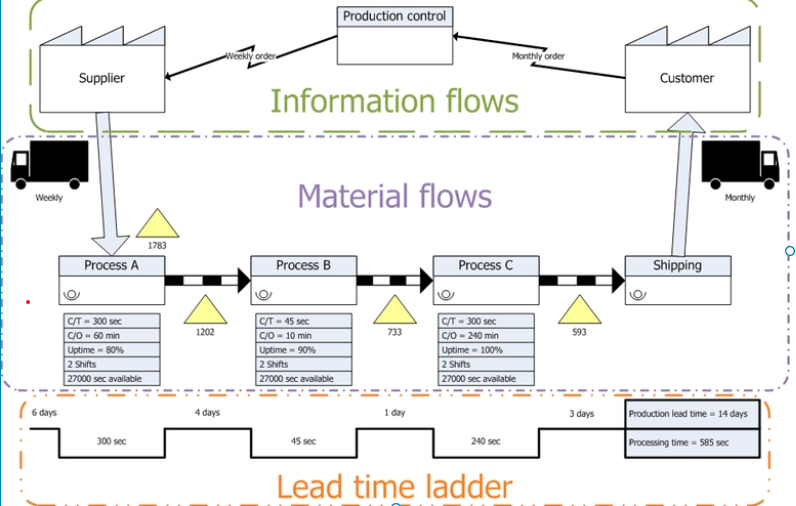
Value Stream Mapping (VSM) adalah tool visual untuk menganalisis dan mendesain flow of materials dan information yang dibutuhkan untuk bring product ke customer Rother & Shook.
Tujuan VSM:
- Visualize entire value stream (current state)
- Identify value-added dan non-value-added activities
- Identify sources of waste
- Design future state map
- Create implementation plan
Types of Value Stream Maps:
| Type | Description | Purpose |
|---|---|---|
| Current State Map | How process works today | Understand现状, identify waste |
| Future State Map | How process should work | Design improved process |
| Implementation Plan | Steps to get from current to future | Execution roadmap |
VSM Symbols:
Process Flow Symbols:
- 🏭 Process Box: Operation atau process step
- 🔺 Inventory: WIP atau stored material
- ➡️ Push Arrow: Push production
- 🎯 Supermarket: Controlled inventory
- 📦 Customer/Supplier: External entities
- 🚚 Transportation: Material movement
Information Flow Symbols:
- 📄 Manual Information: Paper-based
- 💻 Electronic Information: IT systems
- 📅 Schedule: Production schedule
Time Metrics:
- CT (Cycle Time): Time to complete one cycle
- C/O (Changeover Time): Time to change from one product to another
- Uptime: Percentage of time equipment is available
- Lead Time: Total time from order to delivery
Steps in VSM:
- Select Product Family: Choose product or product family to map
- Draw Current State Map:
- Walk the process (gemba walk)
- Collect data: cycle time, changeover time, uptime, inventory levels
- Map material flow dan information flow
- Calculate lead time dan value-added time
- Design Future State Map:
- Identify waste dan elimination opportunities
- Apply Lean principles: pull, flow, takt time
- Design continuous flow cells
- Implement Kanban systems
- Level production (heijunka)
- Create Implementation Plan:
- Break down into projects dan kaizen events
- Assign responsibilities dan timelines
- Set metrics untuk track progress
Key Metrics dari VSM:
Value-Added Ratio = Value-Added Time / Total Lead Time × 100%
Typical Results:
- Traditional manufacturing: 1-5% value-added
- Lean operations: 10-25% value-added
- World-class: 25%+ value-added
🇮🇩 Contoh Lokal: PT Toyota Motor Manufacturing Indonesia (TMMIN)
TMMIN menggunakan VSM untuk optimize production flow di pabrik Avanza dan Fortuner.
Current State Analysis:
- Total lead time: 15 hari
- Value-added time: 4 jam (0.11%)
- WIP inventory: 500 units di antara processes
- Transportation: 12 kali material movement
Future State Design:
- Implement cellular manufacturing: 5 work cells
- Reduce WIP: 500 units → 50 units (90% reduction)
- Implement Kanban: Pull system untuk material replenishment
- Optimize layout: Reduce transportation dari 12 ke 3 movements
- Balance line: Takt time matching customer demand
Results: Lead time turun dari 15 hari ke 3 hari, WIP turun 90%, productivity naik 35%.
🌍 Contoh Global: Dell Technologies – Direct Model VSM
Dell menggunakan VSM untuk design build-to-order model yang revolutionary.
Current State (Traditional PC Manufacturing):
- Build-to-forecast: Produce based on demand forecast
- Lead time: 30-60 days dari order ke delivery
- Inventory: 60-90 days of inventory di channel
- Value-added ratio: < 1%
Future State (Dell Direct Model):
- Build-to-order: Produce only after customer order
- Lead time: 3-5 days dari order ke delivery
- Inventory: 5-7 days of inventory (negative working capital!)
- Value-added ratio: 15%+
- Eliminate distributor dan retailer dari value stream
Results: Inventory turnover 90x/year (vs industry avg 10x), cash conversion cycle negative, market share #1 in PCs.
⚡ 5. Just-In-Time (JIT) & Pull Systems
Definisi JIT
Just-In-Time (JIT) adalah filosofi produksi yang bertujuan untuk memproduksi item yang tepat, pada waktu yang tepat, dalam jumlah yang tepat Toyota.
JIT vs Push Systems:
| Aspect | Push System (Traditional) | Pull System (JIT) |
|---|---|---|
| Trigger | Forecast / Schedule | Actual customer demand |
| Production | Build ahead based on forecast | Build only when needed |
| Inventory | High (safety stock) | Low (minimal buffer) |
| Information Flow | Forward (schedule → production) | Backward (demand → production) |
| Flexibility | Low (locked into schedule) | High (respond to changes) |
| Waste | High (overproduction, inventory) | Low (produce only what’s needed) |
Kanban System:
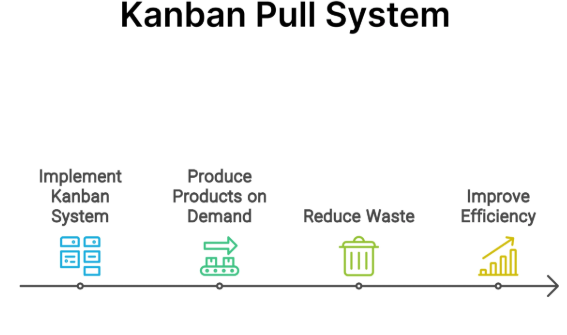
Kanban (看板) adalah “visual signal” yang digunakan untuk control flow of materials dalam pull system JIT Tool.
Types of Kanban:
- Production Kanban (P-Kanban): Authorizes production of specific quantity
- Withdrawal Kanban (W-Kanban): Authorizes withdrawal of materials from supermarket
- Supplier Kanban: Signal to supplier untuk deliver materials
- Emergency Kanban: For urgent needs atau defects
- Express Kanban: For small batch production
Kanban Calculation:
Number of Kanbans = (Demand during Lead Time + Safety Stock) / Container Size
Dimana:
- Demand during Lead Time = Average daily demand × Lead time
- Safety Stock = Buffer untuk variability
- Container Size = Quantity per container
Takt Time:
Takt Time = Available Production Time / Customer Demand
Contoh:
- Available time: 8 jam = 480 menit
- Breaks: 60 menit
- Net available: 420 menit
- Customer demand: 210 units/day
- Takt Time = 420 / 210 = 2 minutes/unit
Artinya: Harus produce 1 unit setiap 2 menit untuk meet demand
JIT Requirements:
- Stable Demand: Level production schedule (heijunka)
- Quality at Source: Zero defects (Poka-Yoke, Jidoka)
- Reliable Suppliers: On-time delivery, quality materials
- Flexible Workforce: Cross-trained employees
- Preventive Maintenance: Equipment reliability
- Standardized Work: Consistent processes
- Layout Optimization: Cellular manufacturing, U-shaped lines
🇮🇩 Contoh Lokal: PT Astra Honda Motor (AHM)
AHM mengimplementasikan JIT system untuk produksi motor Honda (Beat, Vario, PCX, dll).
Penerapan JIT:
- Kanban System: 500+ Kanban cards untuk komponen utama
- Supermarket: Controlled inventory di line-side, max 2 jam supply
- Milk Run: Supplier delivery setiap 2 jam, small batches
- Sequencing: Produksi sesuai sequence dealer orders
- Level Production: Heijunka box untuk level mix model (Beat, Vario, PCX)
- Takt Time: 36 detik/motor (100 detik/motor di line awal)
- JIT with Suppliers: 80% supplier dalam radius 50km dari pabrik
Results: Inventory turnover 120x/year, WIP reduced 70%, lead time dari 7 hari ke 1 hari.
🌍 Contoh Global: Tesla – JIT in Electric Vehicle Manufacturing
Tesla menerapkan JIT dengan pendekatan unik di Gigafactory.
Penerapan JIT:
- Vertical Integration: Banyak komponen diproduksi in-house untuk control
- Over-the-Air Updates: Software updates tanpa physical intervention
- Gigacasting: Single-piece casting reduce 370 parts jadi 1 part
- Direct Sales: No dealer network, direct to customer
- Real-time Demand: Online orders trigger production
- Automated Material Handling: AGVs dan robots untuk material flow
- Vertical Supplier Parks: Key suppliers located adjacent to Gigafactory
Results: Inventory turns 12x/year (vs traditional auto 8x), production cost 30% lower, lead time 2-4 weeks.
🔄 6. Continuous Flow & Cellular Manufacturing
Continuous Flow
Continuous Flow adalah prinsip Lean dimana produk bergerak dari satu process step ke berikutnya tanpa stopping, batching, atau waiting One-Piece Flow.
Batch vs Continuous Flow:
| Aspect | Batch Processing | Continuous Flow |
|---|---|---|
| Lot Size | Large batches (100-1000 units) | Single piece atau small batches (1-10 units) |
| WIP | High (entire batch waits) | Low (minimal buffer) |
| Lead Time | Long (batch waiting time) | Short (continuous movement) |
| Quality Issues | Detected late (entire batch defective) | Detected immediately (one piece at a time) |
| Flexibility | Low (locked into batch) | High (can change anytime) |
| Space | Large (WIP storage) | Small (minimal WIP) |
Cellular Manufacturing:
Cellular Manufacturing adalah layout dimana machines dan workstations diatur dalam cells untuk produce family of parts dengan similar processing requirements.
Types of Cell Layouts:
- U-Shaped Cell:
- Operators dapat cover multiple machines
- Easy communication antar operators
- Flexible staffing (add/remove operators)
- Straight Line Cell:
- Simple linear flow
- Good untuk high volume products
- Circular Cell:
- Compact layout
- Good untuk small parts
Benefits of Cellular Manufacturing:
- Reduced Material Handling: Parts move short distances within cell
- Reduced WIP: Continuous flow minimizes inventory
- Shorter Lead Time: No waiting between operations
- Improved Quality: Problems detected immediately
- Increased Flexibility: Easy to rebalance cells
- Better Communication: Team-based work
- Reduced Space: Compact layout
Line Balancing:
Cycle Time = Available Time / Required Output
Theoretical Minimum Workstations = Sum of Task Times / Cycle Time
Efficiency = (Sum of Task Times) / (Actual Workstations × Cycle Time) × 100%
Balance Delay = 100% – Efficiency
🇮🇩 Contoh Lokal: PT Unilever Indonesia – Cellular Manufacturing
Unilever Indonesia mengimplementasikan cellular manufacturing di pabrik sabun dan shampoo.
Penerapan:
- Product Family Grouping: Group similar products (sabun batang, shampoo sachet, dll)
- U-Shaped Cells: 15 production cells dengan U-shaped layout
- Cross-trained Operators: Setiap operator bisa operate 3-4 machines
- Quick Changeover: SMED untuk change dari satu produk ke produk lain (30 menit → 5 menit)
- Line Balancing: Workload balanced antar workstations (±5% variation)
- Visual Management: Performance boards di setiap cell
Results: Lead time turun 60%, WIP reduced 75%, productivity naik 25%, floor space reduced 40%.
🌍 Contoh Global: Harley-Davidson – Cell Manufacturing Transformation
Harley-Davidson melakukan transformation dari batch production ke cellular manufacturing di 1990-an.
Before (Batch Production):
- Functional layout: All drilling machines together, all welding together
- Lead time: 2-3 weeks untuk motorcycle
- WIP: Massive inventory between departments
- Quality issues: Defects detected late
After (Cellular Manufacturing):
- Product-focused cells: Complete motorcycle assembly in one cell
- Lead time: 2 days untuk motorcycle
- WIP: Reduced 90%
- Quality: Defects detected immediately
- Employee involvement: Self-managed teams
Results: Productivity naik 50%, inventory turns dari 4x ke 20x/year, quality improved dramatically, market share recovered.
🛡️ 7. Poka-Yoke (Mistake-Proofing) & Jidoka
Poka-Yoke (Mistake-Proofing)
Poka-Yoke (ポカヨケ) adalah mekanisme yang mencegah error menjadi defect, atau membuat error tidak mungkin terjadi Shigeo Shingo.
Types of Poka-Yoke:
| Type | Description | Example |
|---|---|---|
| Prevention (Preventive) | Makes it impossible to make error | |
| Detection (Corrective) | Detects error dan stops process | Sensor detects missing part, machine stops |
Poka-Yoke Methods:
- Contact Method: Detect defects by testing product characteristics (shape, size, color)
- Fixed-Value Method: Ensure correct number of movements atau steps
- Motion-Step Method: Ensure steps are completed in correct sequence
Examples of Poka-Yoke:
Manufacturing:
- Asymmetric parts design (only fits one way)
- Sensors to detect missing components
- Color coding untuk prevent mixing
- Limit switches untuk ensure proper positioning
- Checklists dengan mandatory fields
Office/Services:
- Form validation (required fields, format checks)
- Auto-save untuk prevent data loss
- Confirmation dialogs untuk critical actions
- Barcode scanning untuk prevent data entry errors
Jidoka (Autonomation)
Jidoka (自働化) adalah prinsip dimana machines berhenti otomatis saat mendeteksi abnormality, mencegah production of defects TPS.
Jidoka vs Automation:
| Aspect | Automation (自動化) | Jidoka (自働化) |
|---|---|---|
| Focus | Replace human labor | Build quality into process |
| When Problem Occurs | Continues producing defects | Stops automatically |
| Human Role | Monitor machine | Respond to problems, improve process |
| Quality | Inspect after production | Quality at source |
Andon System:
Andon (行灯) adalah visual display yang menunjukkan status production line dan alerts operators ke problems.
- Green Light: Normal operation
- Yellow Light: Problem detected, but line continues
- Red Light: Line stopped, immediate attention needed
- Andon Cord: Any operator can pull cord to stop line
🇮🇩 Contoh Lokal: PT Toyota Motor Manufacturing Indonesia (TMMIN)
TMMIN mengimplementasikan Poka-Yoke dan Jidoka secara extensive di assembly line.
Poka-Yoke Examples:
- Part Feeding:Bins designed so parts can only be picked in correct orientation
- Torque Control: Electric torque wrenches yang stop saat reach target torque
- Part Counting: Sensors count parts, alert jika count tidak match
- Barcode Verification: Scan barcode untuk verify correct part sebelum install
- Go/No-Go Gauges: Physical gauges untuk verify dimensions
Jidoka Implementation:
- Andon System: Every workstation has Andon cord, 500+ cords di assembly line
- Auto-stop: Machines automatically stop jika detect abnormality
- Visual Control: Large Andon board shows status of all stations
- Response Time: Target < 1 minute response ke Andon calls
Results: Defect escape rate < 0.01%, line stoppages used untuk continuous improvement, quality built into process.
🌍 Contoh Global: Intel Corporation – Poka-Yoke in Semiconductor Manufacturing
Intel menggunakan advanced Poka-Yoke di semiconductor fabrication (fab).
Poka-Yoke Examples:
- Wafer Handling: Notches dan flats ensure wafers loaded in correct orientation
- Recipe Verification: System verifies correct process recipe sebelum start
- Particle Detection: In-situ sensors detect particles, stop process jika contamination
- Equipment Interlocks: Doors cannot open during process, chemicals cannot mix incorrectly
- Automated Inspection: AI-based visual inspection untuk defect detection
Jidoka Implementation:
- Equipment Monitoring: 1000+ sensors per tool, real-time monitoring
- Auto-stop: Tools automatically stop jika parameters out of spec
- Predictive Maintenance: AI predicts tool failures sebelum terjadi
- Defect Excursion: Automatic lot hold jika defect rate exceeds threshold
Results: Yield > 95% untuk advanced nodes, defect density < 0.1 defects/cm², billions of transistors per chip with near-zero defects.
⚖️ 8. Heijunka (Production Leveling)
Definisi Heijunka
Heijunka (平準化) adalah teknik untuk level volume dan mix of production over specified time period untuk reduce waste dan improve flow TPS.
Mengapa Leveling Penting?
Problem dengan Unleveled Production:
- Mura (Unevenness): Fluctuating demand menyebabkan overburden (Muri) dan waste (Muda)
- Bullwhip Effect: Small demand variations amplify upstream
- Inventory Problems: High inventory during low demand, shortages during high demand
- Quality Issues: Rushing during peak periods leads to defects
- Employee Stress: Overwork during peaks, idle time during valleys
Types of Leveling:
| Type | Description | Example |
|---|---|---|
| Volume Leveling | Level total production volume | Produce 100 units/day instead of 200 on Monday, 0 on Tuesday |
| Mix Leveling | Level product mix | Produce A-B-A-B-A-B instead of A-A-A-B-B-B |
Heijunka Box:
Heijunka Box adalah visual tool untuk schedule production dalam leveled sequence.
Structure:
- Rows: Different products (Product A, B, C, dll)
- Columns: Time periods (usually 30-minute atau 1-hour intervals)
- Cards: Kanban cards placed in boxes untuk schedule production
Example:
- Time period: 30 minutes
- Products: A, B, C
- Pattern: A-B-C-A-B-C-A-B-C (leveled mix)
- Instead of: A-A-A-B-B-B-C-C-C (batch production)
Benefits of Heijunka:
- Reduce Inventory: No need for safety stock untuk demand peaks
- Improve Quality: Consistent pace reduces errors
- Increase Flexibility: Can respond to demand changes
- Reduce Muri: No overburden pada employees atau equipment
- Better Resource Utilization: Smooth workload
- Shorter Lead Time: Continuous flow
Heijunka Calculation:
Production Interval = Total Production Time / Total Demand
Contoh:
- Available time: 480 minutes
- Demand: A=50, B=30, C=20 (total 100 units)
- Production interval = 480 / 100 = 4.8 minutes/unit
- Sequence: A-B-C-A-B-C-A-B-C… (repeat pattern)
- Every 4.8 minutes, produce 1 unit (mix of A, B, C)
🇮🇩 Contoh Lokal: PT Astra Daihatsu Motor (ADM)
ADM mengimplementasikan Heijunka untuk produksi mobil Daihatsu (Xenia, Ayla, Rocky).
Penerapan:
- Daily Leveling: Produce 800 units/day (vs 1200 on peak days, 400 on low days)
- Mix Leveling: Sequence: Xenia-Ayla-Rocky-Xenia-Ayla-Rocky (leveled mix)
- Heijunka Box: Visual scheduling di line-side
- Flexible Workforce: Cross-trained operators untuk handle different models
- Quick Changeover: SMED untuk change dari Xenia ke Ayla (8 minutes)
- Supplier Leveling: Suppliers deliver in leveled sequence (milk run)
Results: Inventory reduced 60%, lead time dari 5 hari ke 2 hari, productivity naik 20%, quality improved.
🌍 Contoh Global: Toyota Global Production System
Toyota menerapkan Heijunka di semua plants worldwide sebagai core of TPS.
Penerapan:
- Monthly Leveling: Set monthly production volume, adjust daily
- Daily Leveling: Level production across working days
- Hourly Leveling: Level mix within each hour
- Sequence Leveling: Optimize sequence untuk minimize changeover
- Global Coordination: Coordinate production across plants untuk balance load
- Dealer Order Integration: Heijunka based on actual dealer orders, bukan forecast
Results: Industry-leading inventory turns (100+ per year), highest quality, lowest cost, most flexible production system.
🔧 9. SMED (Single-Minute Exchange of Die)
Definisi SMED
SMED (Single-Minute Exchange of Die) adalah metodologi untuk reduce changeover time ke under 10 minutes (single-digit minutes) Shigeo Shingo.
Mengapa Changeover Reduction Penting?
- Enable Small Batches: Short changeover allows economic production of small lots
- Reduce Inventory: Small batches = less WIP dan finished goods
- Increase Flexibility: Can respond to demand changes quickly
- Improve Quality: Less setup time = less opportunity for errors
- Increase Capacity: More productive time, less downtime
SMED Methodology – 4 Stages:
| Stage | Description | Typical Result |
|---|---|---|
| 1. Separate Internal dan External Setup | Identify which tasks can be done while machine is running (external) vs must be done when machine is stopped (internal) | 30-50% reduction |
| 2. Convert Internal to External | Find ways to do internal tasks externally | 50-70% reduction |
| 3. Streamline All Aspects | Optimize both internal dan external tasks | 70-90% reduction |
| 4. Continuous Improvement | Keep improving changeover process | 90%+ reduction |
SMED Techniques:
Separate Internal/External:
- Video record changeover process
- List all tasks
- Classify as internal atau external
- Perform external tasks while machine is running
Convert Internal to External:
- Pre-stage tools dan materials
- Use intermediate dies (standardize)
- Pre-heat materials
- Use functional clamps instead of bolts
Streamline Tasks:
- Use quick-fasteners (one-touch, cam locks)
- Eliminate adjustments (use stops, guides)
- Standardize components
- Use parallel operations (two people working together)
- Mechanize atau automate where possible
🇮🇩 Contoh Lokal: PT Kalbe Farma – SMED in Pharmaceutical Manufacturing
Kalbe Farma mengimplementasikan SMED di tablet compression machines untuk reduce changeover time antar produk.
Before SMED:
- Changeover time: 4 jam (240 minutes)
- Batch size: 500,000 tablets (large batches untuk amortize changeover)
- Inventory: High finished goods inventory
SMED Implementation:
- Stage 1: Separate internal/external – pre-stage tools, prepare documentation externally
- Stage 2: Convert internal to external – pre-assemble tooling, use cartridge systems
- Stage 3: Streamline – quick-release clamps, color-coded parts, standardized settings
- Stage 4: Continuous improvement – video analysis, kaizen events
After SMED:
- Changeover time: 25 minutes (90% reduction!)
- Batch size: 50,000 tablets (10x smaller batches)
- Inventory: Reduced 70%
- Flexibility: Can respond to demand changes same day
🌍 Contoh Global: Formula 1 Racing – SMED in Pit Stops
F1 teams are masters of SMED, with pit stops (changeovers) taking only 2-3 seconds!
SMED Techniques in F1:
- Separate Internal/External: Prepare tires, fuel, tools before car arrives
- Convert Internal to External: Pre-heat tires, pre-mix fuel
- Streamline:
- Wheel guns: 5x torque in 2 seconds
- 20+ person pit crew (parallel operations)
- Practice: 1000+ pit stop rehearsals per season
- Video analysis: Frame-by-frame improvement
- Standardized positions dan movements
Results: Pit stop time dari 30+ seconds (1950s) ke 1.82 seconds (2023 Red Bull record). This is ultimate SMED!
🔄 10. Kaizen & Continuous Improvement
Definisi Kaizen
Kaizen (改善) adalah filosofi Jepang untuk continuous improvement yang melibatkan semua employees dalam perbaikan bertahap dan berkelanjutan Masaaki Imai.
Kaizen vs Innovation:
| Aspect | Kaizen | Innovation |
|---|---|---|
| Pace | Small, gradual steps | Large, breakthrough changes |
| Who | Everyone | Specialists, R&D |
| Cost | Low cost | High investment |
| Risk | Low risk | High risk |
| Frequency | Continuous | Periodic |
| Examples | 5S, waste elimination, process tweaks | New product, new technology, new plant |
PDCA Cycle (Deming Cycle):
PLAN: Identify problem, analyze root cause, develop solution
⬇️
DO: Implement solution on small scale (pilot)
⬇️
CHECK: Measure results, compare to expectations
⬇️
ACT: Standardize if successful, adjust if needed, plan next cycle
⬆️ (Continuous cycle)
Types of Kaizen:
- Kaizen Teian (Suggestion System): Individual employees submit improvement ideas
- Quality Circles: Small groups meet regularly to solve quality problems
- Kaizen Events (Blitz): Focused 3-5 day improvement projects
- Kaizen Teikan: Systematic, ongoing improvement activities
- Gemba Kaizen: Improvement done at actual workplace (gemba)
Kaizen Event Process:
- Pre-Event (2-4 weeks before):
- Select topic dan scope
- Assemble cross-functional team
- Collect baseline data
- Schedule event
- Day 1: Training dan Current State:
- Train team on Lean tools
- Go to gemba, observe current state
- Collect data, map current state
- Day 2-3: Analysis dan Solution Generation:
- Identify root causes
- Brainstorm solutions
- Select best solutions
- Day 4: Implementation:
- Implement solutions (quick changes)
- Test dan validate
- Adjust as needed
- Day 5: Standardize dan Follow-up:
- Document new standard
- Train employees
- Create follow-up plan
- Celebrate success!
🇮🇩 Contoh Lokal: PT Semen Indonesia – Kaizen Program
Semen Indonesia mengimplementasikan comprehensive Kaizen program di semua plants.
Kaizen Teian (Suggestion System):
- Target: 10 suggestions per employee per year
- Implementation rate: 75% of suggestions implemented
- Rewards: Monthly awards untuk best suggestions
- Total suggestions: 25,000+ per year
Kaizen Events:
- 50+ Kaizen events per year
- Focus areas: Energy efficiency, material handling, quality improvement
- Average saving per event: Rp 200 million
- Total annual saving: Rp 10+ billion
Quality Circles:
- 200+ quality circles active
- Monthly meetings untuk solve problems
- Annual QCC convention untuk share best practices
Results: Productivity naik 30%, energy consumption turun 20%, quality improved, employee engagement tinggi.
🌍 Contoh Global: Continental AG – Kaizen in Automotive Manufacturing
Continental (German automotive supplier) mengimplementasikan Kaizen di 200+ plants worldwide.
Kaizen System:
- Continuous Improvement Process (CIP): Structured approach to Kaizen
- Idea Management System: Digital platform untuk submit dan track ideas
- Kaizen Promoters: Trained facilitators di setiap plant
- Kaizen Days: Annual events untuk share best practices across plants
- Lean Academy: Training programs untuk build Kaizen capabilities
Metrics:
- 100,000+ improvement ideas per year
- €100+ million annual savings
- 80% implementation rate
- Every employee submits average 5 ideas per year
Culture: Kaizen is part of DNA, “We improve every day” is company motto.
🏥 11. Lean in Services & Healthcare
Lean Beyond Manufacturing
Lean principles dapat diterapkan di service industries, healthcare, government, dan non-manufacturing sectors Lean Services.
Lean Services vs Lean Manufacturing:
| Aspect | Lean Manufacturing | Lean Services |
|---|---|---|
| Output | Tangible products | Intangible services |
| Customer Contact | Low (back-office) | High (front-office) |
| Inventory | Physical inventory | Information, customers in queue |
| Quality | Product specifications | Customer experience |
| Waste | 7 wastes (TIMWOOD) | 8 wastes (adding unused talent) |
| Flow | Material flow | Information flow, customer flow |
8 Wastes in Services:
- Transportation: Moving information atau people unnecessarily
- Inventory: Excess information, backlogs, customers waiting
- Motion: Searching for information, unnecessary movements
- Waiting: Customers waiting, employees waiting for approvals
- Overproduction: Reports no one reads, features no one uses
- Overprocessing: Redundant approvals, excessive documentation
- Defects: Errors, rework, customer complaints
- Unused Talent: Not using employee skills dan creativity
Lean Healthcare:
Lean diterapkan di healthcare untuk improve patient outcomes, reduce costs, dan enhance patient experience.
Applications in Healthcare:
- Patient Flow: Reduce waiting times di emergency department
- Medication Management: Reduce medication errors
- Surgical Process: Optimize operating room utilization
- Lab Services: Reduce turnaround time untuk test results
- Supply Chain: JIT delivery of medical supplies
- Administrative Processes: Streamline billing, admissions, discharge
🇮🇩 Contoh Lokal: RS Siloam – Lean Healthcare
RS Siloam mengimplementasikan Lean untuk improve patient flow dan reduce waiting times.
Applications:
- Emergency Department:
- Value stream mapping of patient flow
- Reduce registration time dari 15 menit ke 3 menit
- Triage system untuk prioritize patients
- Result: Waiting time turun 60%
- Operating Room:
- SMED untuk turnover between surgeries
- Standardized surgical kits (5S)
- Result: OR utilization naik dari 60% ke 85%
- Pharmacy:
- Kanban system untuk medication replenishment
- Barcode scanning untuk prevent medication errors
- Result: Medication errors turun 80%
- Lab Services:
- Cellular layout untuk lab processes
- Automated result delivery
- Result: Turnaround time dari 4 jam ke 1 jam
Results: Patient satisfaction naik 35%, operational costs turun 20%, quality improved significantly.
🌍 Contoh Global: Virginia Mason Medical Center (Seattle, USA)
Virginia Mason adalah pioneer Lean healthcare, mengadopsi Toyota Production System sebagai “Virginia Mason Production System” (VMPS).
VMPS Implementation:
- Patient Value: Define value from patient perspective
- Value Stream Mapping: Map all patient processes
- Flow: Create continuous patient flow
- Pull: Pull-based scheduling
- Perfect: Continuous improvement culture
Key Improvements:
- Nurse Walking: Reduced nurse walking dari 5 miles/day ke 1.5 miles/day (more time for patients)
- Medication Delivery: JIT delivery to patient rooms, reduce nursing time 40%
- Operating Room: OR turnover time reduced 50%
- Patient Wait Times: Reduced 70% across all departments
- Quality: Zero patient deaths from medication errors (vs 4000/year in US)
Results: $1 billion+ savings over 15 years, patient satisfaction #1 in region, quality awards.
🔗 12. Lean Six Sigma Integration
Lean + Six Sigma = Lean Six Sigma
Lean Six Sigma adalah integrasi Lean (focus on speed dan waste elimination) dengan Six Sigma (focus on quality dan variation reduction) Combined Approach.
Lean vs Six Sigma:
| Aspect | Lean | Six Sigma |
|---|---|---|
| Focus | Speed, waste elimination | Quality, variation reduction |
| Goal | Flow, efficiency | 3.4 DPMO, perfection |
| Tools | 5S, VSM, Kanban, Poka-Yoke | DMAIC, SPC, DOE, MSA |
| Approach | Visual, intuitive | Statistical, data-driven |
| Strength | Quick wins, culture change | Complex problems, root cause |
| Weakness | May not solve complex quality issues | Can be slow, too technical |
Benefits of Integration:
- Comprehensive: Address both speed dan quality
- Synergy: Lean tools make processes faster, Six Sigma makes them better
- Flexibility: Choose right tool for right problem
- Culture: Combines continuous improvement (Lean) dengan data-driven decisions (Six Sigma)
Lean Six Sigma Belt System:
- White Belt – Basic awareness (4 hours training)
- Yellow Belt – Team member, basic tools (1-2 days training)
- Green Belt – Lead small projects, part-time (2-4 weeks training)
- Black Belt – Lead complex projects, full-time (4-6 weeks training)
- Master Black Belt – Mentor, trainer, strategic leader
- Champion – Executive sponsor
Lean Six Sigma Methodology:
DMAIC Framework (dengan Lean tools):
- Define:
- Project charter
- Voice of Customer (VOC)
- Value Stream Mapping (current state)
- Measure:
- Data collection plan
- Measurement System Analysis (MSA)
- Process capability studies
- Analyze:
- Root cause analysis (5 Whys, Fishbone)
- Statistical analysis (hypothesis testing, regression)
- Waste identification
- Improve:
- Solution generation (brainstorming)
- Pilot testing
- Lean tools implementation (5S, Kanban, Poka-Yoke)
- Design of Experiments (DOE)
- Control:
- Statistical Process Control (SPC)
- Standard work documentation
- Visual management
- Control plan
🇮🇩 Contoh Lokal: PT Bank Mandiri – Lean Six Sigma
Bank Mandiri mengimplementasikan Lean Six Sigma untuk improve banking processes.
Project Example: Reduce Credit Card Application Processing Time
- Define: Current lead time 14 days, target 5 days
- Measure: Data collection, current process capability Cpk = 0.8
- Analyze: Root causes: 60% waiting for approvals, 25% rework due to incomplete applications, 15% system delays
- Improve:
- Implement online application system (reduce incomplete applications)
- Automated credit scoring (reduce manual review)
- Parallel processing (instead of sequential)
- Standardize approval workflow (reduce waiting)
- Control: SPC charts untuk monitor processing time, control plan, training
Results: Lead time dari 14 hari ke 3.5 days (75% reduction), Cpk improved dari 0.8 ke 1.67, customer satisfaction naik 40%.
🌍 Contoh Global: GE (General Electric) – Lean Six Sigma Transformation
GE under Jack Welch became world’s most successful Lean Six Sigma deployment.
Implementation:
- Company-wide: All 300,000+ employees trained
- Leadership: All executives must be Black Belt certified
- Projects: 40,000+ Six Sigma projects per year
- Financial Impact: $12+ billion savings in first 5 years
- Culture: Six Sigma became part of GE DNA
Example Project: Aircraft Engine Manufacturing
- Problem: High variation in turbine blade dimensions
- Lean: Cellular manufacturing, JIT material flow
- Six Sigma: DOE to optimize machining parameters, SPC for monitoring
- Results: Variation reduced 80%, yield improved dari 85% ke 98%, cost savings $50 million/year
Legacy: GE’s success made Lean Six Sigma the gold standard for operational excellence worldwide.
🚀 13. Lean 4.0 & Future Trends
Lean 4.0: Lean Meets Industry 4.0
Lean 4.0 adalah integrasi Lean principles dengan Industry 4.0 technologies untuk create next-generation operational excellence Digital Lean.
Industry 4.0 Technologies for Lean:
| Technology | Lean Application | Benefit |
|---|---|---|
| IoT (Internet of Things) | Real-time monitoring of equipment, materials, processes | Early problem detection, predictive maintenance |
| AI & Machine Learning | Predictive analytics, automated decision making | Optimize processes, predict demand, prevent defects |
| Big Data Analytics | Advanced analytics untuk identify waste patterns | Data-driven waste elimination |
| Cloud Computing | Centralized data, collaboration platforms | Real-time information sharing |
| Augmented Reality (AR) | Visual work instructions, remote assistance | Reduce errors, faster training |
| Digital Twin | Virtual simulation of processes | |
| Robotics & Automation | Collaborative robots (cobots), AGVs | Flexible automation, reduce muda |
| Blockchain | Supply chain transparency, traceability | Trust, quality verification |
Digital Lean Tools:
Digital Value Stream Mapping:
- Real-time data collection (no manual data entry)
- Dynamic updates (map changes automatically)
- Advanced analytics (identify hidden waste patterns)
- Simulation (test improvements digitally)
Digital Kanban:
- Electronic Kanban (e-Kanban)
- Real-time inventory tracking
- Automated replenishment signals
- Integration with ERP systems
Digital Andon:
- Mobile Andon (alerts to smartphones)
- Real-time dashboards
- Automated escalation
- Integration with maintenance systems
Digital 5S:
- 5S audit apps (digital checklists)
- Photo documentation
- Automated scoring dan reporting
- AI-based 5S compliance monitoring
Benefits of Lean 4.0:
- Real-time Visibility: See waste as it happens
- Predictive Capabilities: Prevent problems before they occur
- Automation of Routine Tasks: Free humans for value-added work
- Enhanced Decision Making: Data-driven decisions
- Flexibility: Quick reconfiguration untuk changing demands
- Scalability: Easy to scale Lean across multiple sites
🇮🇩 Contoh Lokal: PT Astra Otoparts – Lean 4.0
Astra Otoparts mengimplementasikan Lean 4.0 di manufacturing plants.
Digital Lean Initiatives:
- IoT Sensors: 5000+ sensors untuk real-time monitoring of machines
- Digital Andon: Mobile alerts ke supervisors saat machine stops
- AI-based Quality: Computer vision untuk automated inspection (99.5% accuracy)
- Digital VSM: Real-time value stream mapping dengan automated data collection
- Predictive Maintenance: AI predicts machine failures 48 hours in advance
- AGVs: Automated guided vehicles untuk material transport
- Digital Work Instructions: Tablet-based instructions dengan 3D animations
Results: OEE naik dari 65% ke 85%, defect rate turun 70%, energy consumption turun 25%, productivity naik 40%.
🌍 Contoh Global: Siemens – Lean 4.0 Pioneer
Siemens adalah leader dalam Lean 4.0, mengintegrasikan Lean dengan digital technologies di 300+ factories.
Digital Lean Ecosystem:
- MindSphere: Industrial IoT platform untuk collect dan analyze data
- Digital Twin: Complete digital twin of factories, products, processes
- AI Quality Inspector: Deep learning untuk automated optical inspection
- AR Maintenance: Technicians use AR glasses untuk guided maintenance
- Blockchain: Supply chain traceability untuk aerospace components
- Cloud QMS: Centralized quality management system
- Digital Kanban: E-Kanban integrated with ERP
Results: Quality costs turun 30%, time-to-market 50% faster, zero-defect manufacturing di beberapa lines, 100% traceability.
Future of Lean:
- Autonomous Lean: AI-driven continuous improvement
- Hyper-connected Lean: Full integration across value chain
- Sustainable Lean: Integration with sustainability goals
- Human-centric Lean: Focus on employee well-being dan development
- Lean in Metaverse: Virtual factories untuk training dan optimization
📚 14. Referensi dan Bahan Bacaan Lanjutan
Referensi Utama:
- Collier, D. A., & Evans, J. R. (2021). Operations and Supply Chain Management. Chapter 18: Lean Operations. Boston: Cengage.
Buku Teks Rekomendasi:
- Womack, J. P., & Jones, D. T. (2003). Lean Thinking: Banish Waste and Create Wealth in Your Corporation. Free Press.
- Liker, J. K. (2004). The Toyota Way: 14 Management Principles from the World’s Greatest Manufacturer. McGraw-Hill.
- Imai, M. (1986). Kaizen: The Key to Japan’s Competitive Success. McGraw-Hill.
- Shingo, S. (1988). Non-Stock Production: The Shingo System for Continuous Improvement. Productivity Press.
- Rother, M., & Shook, J. (1999). Learning to See: Value Stream Mapping to Add Value and Eliminate Muda. Lean Enterprise Institute.
- Dennis, P. (2015). Lean Production Simplified (3rd ed.). Productivity Press.
Jurnal Ilmiah:
- Journal of Lean Thinking
- International Journal of Production Research
- Journal of Operations Management
- Production and Operations Management
- Lean Construction Journal
Organisasi dan Resources:
- Lean Enterprise Institute: www.lean.org
- Toyota Production System Support Center: www.tps.jp
- Shingo Institute: www.shingo.org (for operational excellence)
- Lean Global Network: www.leanglobal.org
- Indonesia Lean Forum: Community untuk Lean practitioners di Indonesia
Video Pembelajaran:
- Kunjungi channel YouTube untuk video kuliah sesi 13
- Link: https://aurinoworks.com/oscm-sesi-13/
- Workshop: Hands-on Lean tools application
Online Resources:
- Lean Lexicon: www.lean.org/lexicon
- Lean Blog: www.leanenterprise.org/blog
- Toyota Way Blog: www.toyota-way.com
- iLean: www.ilean.com
📋 Ringkasan Materi Sesi 13
Lean Operations adalah filosofi manajemen yang berfokus pada penghapusan waste secara sistematis untuk menciptakan value maksimal bagi pelanggan dengan sumber daya minimal.
Key Takeaways:
- 5 Prinsip Lean: Value, Value Stream, Flow, Pull, Perfection
- 7+1 Wastes (TIMWOOD+S): Transportation, Inventory, Motion, Waiting, Overproduction, Overprocessing, Defects, Unused talent
- 5S: Sort, Set in Order, Shine, Standardize, Sustain
- Value Stream Mapping: Visual tool untuk analyze dan design flow
- JIT & Pull Systems: Produce only what’s needed, when it’s needed
- Kanban: Visual signal untuk control material flow
- Continuous Flow & Cellular Manufacturing: One-piece flow, U-shaped cells
- Poka-Yoke: Mistake-proofing untuk prevent defects
- Jidoka: Autonomation, machines stop automatically saat detect abnormality
- Heijunka: Production leveling untuk reduce unevenness
- SMED: Quick changeover (< 10 minutes) untuk enable small batches
- Kaizen: Continuous improvement involving everyone
- Lean in Services: Apply Lean principles beyond manufacturing
- Lean Six Sigma: Integration of Lean (speed) + Six Sigma (quality)
- Lean 4.0: Integration of Lean dengan Industry 4.0 technologies
Contoh Penerapan:
- Lokal: Toyota Indonesia (TPS), Astra Otoparts (Waste reduction), Indofood (5S), Unilever (Cellular manufacturing), AHM (JIT/Kanban), Kalbe Farma (SMED), Semen Indonesia (Kaizen), RS Siloam (Lean healthcare), Bank Mandiri (Lean Six Sigma)
- Global: Toyota (TPS), Nike (Waste reduction), Boeing (5S), Dell (VSM/Direct model), Tesla (JIT), Harley-Davidson (Cellular), Intel (Poka-Yoke), F1 Racing (SMED), Continental (Kaizen), Virginia Mason (Lean healthcare), GE (Lean Six Sigma), Siemens (Lean 4.0)
Lean is Not Just Tools – It’s a Mindset!
Lean requires commitment to continuous improvement, respect for people, dan focus on customer value. It’s a journey, not a destination.
Operasi Ramping (Lean Operations)
4
1. Tujuan Sesi
Sesi ini bertujuan memperkenalkan Lean Operations sebagai pendekatan manajerial untuk meningkatkan nilai bagi pelanggan dengan menghilangkan pemborosan (waste) dan memperbaiki aliran proses. Mahasiswa diarahkan memahami lean sebagai cara berpikir sistemik, bukan sekadar kumpulan alat.
Fokus sesi adalah bagaimana prinsip lean membantu organisasi mencapai kualitas lebih baik, waktu lebih singkat, dan biaya lebih rendah secara berkelanjutan.
2. Konsep Dasar Lean Thinking
Lean Thinking berangkat dari pertanyaan mendasar: apa yang benar-benar bernilai bagi pelanggan? Segala aktivitas yang tidak menambah nilai dipandang sebagai pemborosan yang perlu dikurangi atau dihilangkan.
Pendekatan ini menuntut disiplin dalam melihat proses apa adanya dan keberanian untuk menantang kebiasaan lama yang tidak lagi relevan.
3. Pemborosan (Waste) dalam Operasi
Pemborosan mencakup berbagai aktivitas yang mengonsumsi sumber daya tanpa menciptakan nilai, seperti waktu tunggu, transportasi berlebih, persediaan berlebihan, dan pekerjaan ulang. Banyak pemborosan tersembunyi dalam proses yang sudah dianggap “normal”.
Mahasiswa belajar bahwa mengidentifikasi waste merupakan langkah awal yang krusial dalam perbaikan proses berbasis lean.
4. Aliran Proses (Flow) dan Sistem Tarik (Pull)
Lean menekankan flow yang lancar—produk atau layanan bergerak tanpa hambatan dan penundaan. Sistem pull memastikan produksi atau layanan dipicu oleh permintaan aktual pelanggan, bukan oleh dorongan internal.
Pendekatan ini membantu mengurangi persediaan, waktu tunggu, dan variasi proses.
5. Value Stream Mapping (VSM)
Value Stream Mapping digunakan untuk memetakan seluruh aliran nilai dari hulu ke hilir, termasuk aliran material dan informasi. VSM membantu organisasi melihat hubungan antar proses dan mengidentifikasi area pemborosan secara menyeluruh.
Dalam konteks pembelajaran, VSM melatih mahasiswa berpikir end-to-end, bukan parsial.
6. Kaizen dan Perbaikan Berkelanjutan
Kaizen menekankan perbaikan kecil yang dilakukan secara terus-menerus oleh seluruh anggota organisasi. Pendekatan ini membangun budaya belajar dan keterlibatan karyawan dalam peningkatan kinerja.
Mahasiswa diajak memahami bahwa perbaikan berkelanjutan lebih efektif jika menjadi kebiasaan, bukan proyek sesaat.
7. Peran Manusia dalam Lean Operations
Lean menghargai peran manusia sebagai sumber ide dan inovasi perbaikan. Keterlibatan karyawan sangat penting untuk mengidentifikasi pemborosan dan menjaga keberlanjutan perubahan.
Tanpa keterlibatan manusia, lean berisiko menjadi sekadar program efisiensi jangka pendek.
8. 🎥 Video Pendukung
Tambahkan video pengantar tentang:
Lean Operations and Waste Elimination
atau
Value Stream Mapping Basics
🔔 Catatan:
Video digunakan untuk membantu visualisasi prinsip lean, aliran proses, dan identifikasi pemborosan, bukan sebagai pengganti pembahasan konseptual.
Key Takeaway
Lean Operations adalah filosofi manajemen yang berfokus pada penciptaan nilai melalui pengurangan pemborosan dan perbaikan proses secara berkelanjutan.